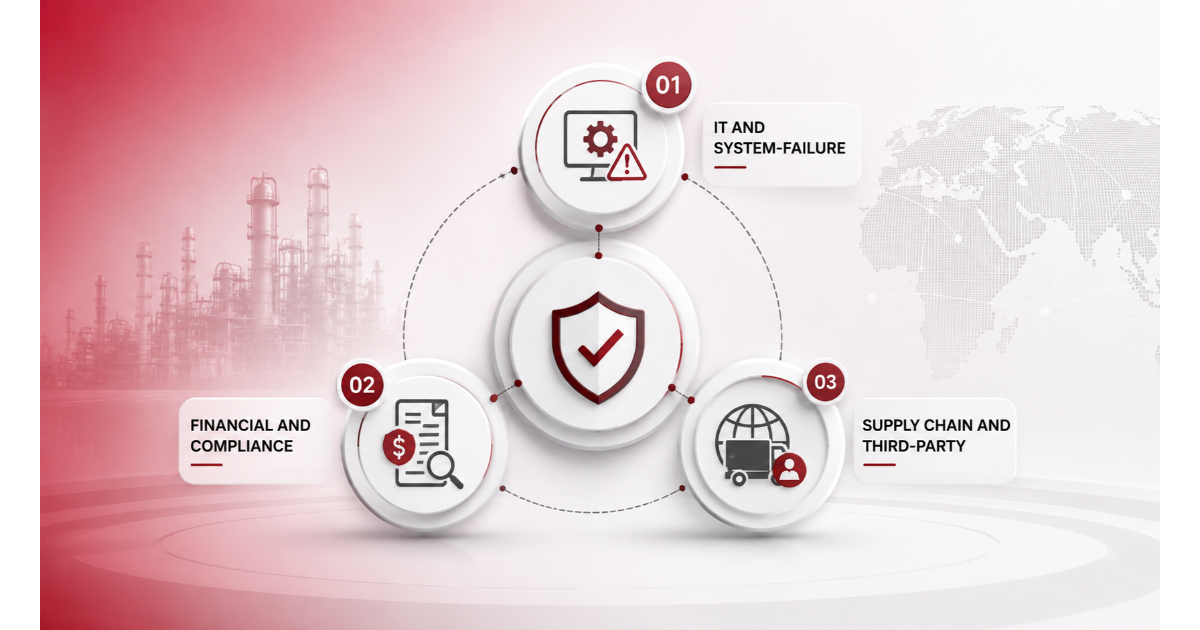
When the FCA reviewed operational incidents reported by UK financial firms between 2022 and 2023, third-party providers came back as the leading cause, not internal system failures or human error. [Source: Financial Conduct Authority, post-CrowdStrike guidance, 2024] For banks, the operational risk that matters most increasingly originates outside the bank's own walls, in a vendor's data center, a cloud provider's update pipeline, or a subcontractor several layers removed from the original contract.
What Is Third-Party Operational Risk in Banking?
Third-party operational risk in banking is the risk that a vendor, service provider, or their own subcontractors disrupt a bank's ability to deliver critical services, whether through a system failure, a security incident, or a compliance gap.
It sits inside the broader operational risk category but requires distinct oversight, since a bank cannot directly control a vendor's internal processes.
Why Regulators Now Treat Vendor Risk as Operational Risk
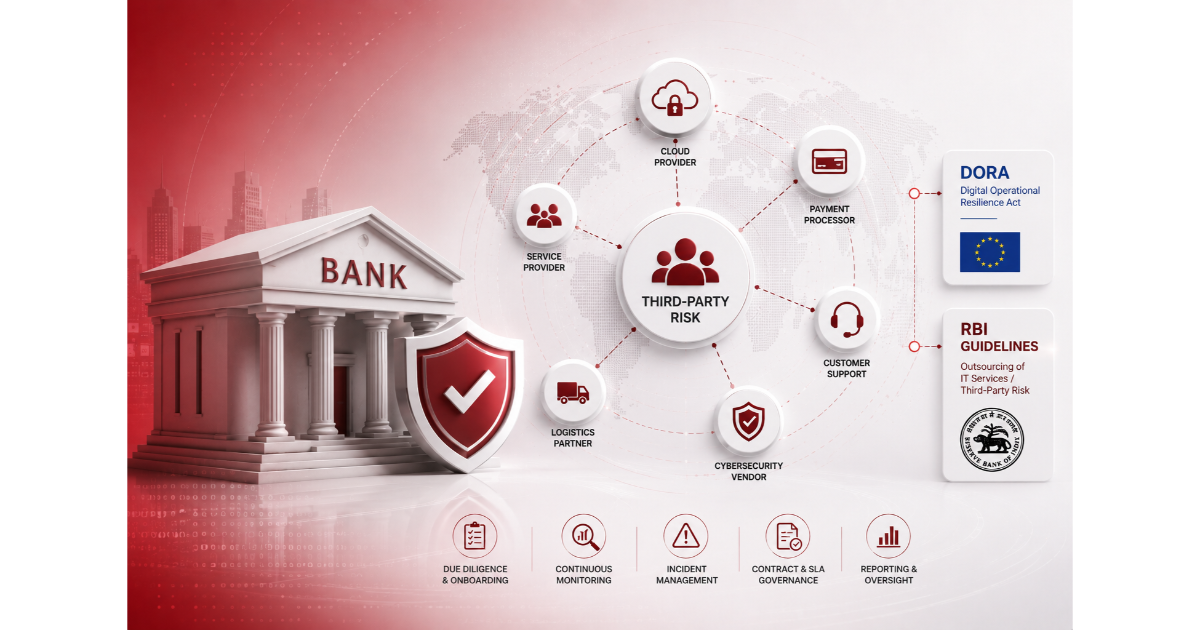
Regulatory frameworks in multiple jurisdictions have moved from treating third-party oversight as a contractual matter to treating it as core operational risk management, with specific, binding requirements.
DORA's ICT third-party requirements
The EU's Digital Operational Resilience Act, in force since January 2025, requires financial entities to maintain a current register of ICT third-party providers, assess concentration risk across the vendor portfolio, and build resilience testing that includes third-party failure scenarios. [Source: European Union, Digital Operational Resilience Act] DORA folds vendor risk directly into the same operational resilience requirements that apply to a bank's own systems, treating it as one continuous obligation rather than a separate compliance track.
RBI's outsourcing guidelines
The Reserve Bank of India's Guidelines on Managing Risks and Code of Conduct in Outsourcing of Financial Services require board-level oversight of material outsourcing arrangements, documented due diligence before engaging a service provider, and continuous monitoring for the life of the relationship, applying to banks, NBFCs, and other RBI-regulated entities. The guidelines treat outsourcing risk as a standing governance obligation rather than a one-time onboarding checklist.
Multi-Region Governance and the First/Second-Line Split
Banks operating across multiple regions face a governance challenge that single-market institutions do not: a vendor risk decision often needs sign-off from risk teams in more than one jurisdiction, each operating under its own regulatory framework and its own interpretation of first and second line responsibilities. A vendor evaluation that clears one region's first-line review can stall in another region's second-line challenge process, not because the vendor's risk changed, but because the governance structures were never reconciled.
Banks that handle this well tend to standardize the underlying risk data, the assessment scores, the evidence, the monitoring feed, across every region, even when the governance sign-off process itself stays region-specific. Standardizing the process alone, without standardizing the underlying data, tends to just move the friction from one stage of the workflow to another.
Concentration Risk: When One Vendor Becomes Systemic
Concentration risk is what happens when a bank, or an entire sector, depends heavily on a small number of vendors for a critical function. The July 2024 CrowdStrike outage demonstrated this at scale: a single cybersecurity vendor's faulty update disrupted banks, airlines, and hospitals across multiple countries simultaneously, not because any one bank had weak controls, but because so many institutions relied on the same vendor for the same function. [Source: U.S. Congressional Research Service, July 2024]
DORA explicitly requires financial entities to assess and mitigate concentration risk for exactly this reason, since a bank's own due diligence on a single vendor cannot address the systemic exposure created when an entire industry relies on the same handful of providers.
How ComplyScore® Supports Bank Vendor Risk Programs
ComplyScore® maps assessments to RBI outsourcing requirements and DORA's ICT third-party provisions directly, so evidence collected once can satisfy multiple regulatory frameworks rather than requiring separate assessment cycles for each jurisdiction a bank operates in. Continuous monitoring surfaces vendor concentration patterns across the full portfolio, giving risk teams visibility into shared-vendor exposure before a single point of failure becomes a systemic one.
Because the same operational risk management platform runs across regions with a consistent underlying data model, multi-region governance teams can apply their own local sign-off process without maintaining separate, disconnected assessment data for each jurisdiction.
See how ComplyScore® supports bank third-party risk programs. Book a demo








.webp?width=387&height=387&name=headless-tprm%20(1).webp)














































%20(1).jpg)