A single line of unreviewed code cost one trading firm $440 million in under an hour. A faulty software update from one cybersecurity vendor grounded flights and disrupted banks across several continents in a single morning. Neither event started as a headline risk. Both started as a specific, narrow type of operational risk that nobody was watching closely enough at the moment it mattered.
What Are the Types of Operational Risk Management?
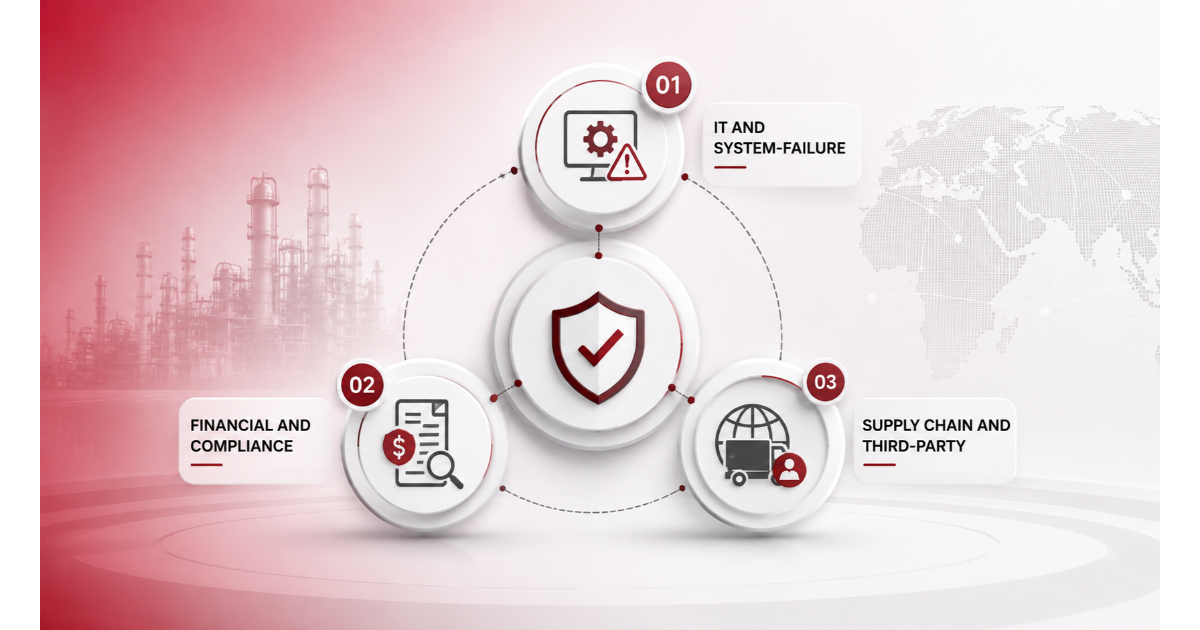
Operational risk management splits into distinct categories based on where the risk originates, including IT and system failures, financial and compliance breakdowns, and disruption introduced through third parties and supply chains.
Each category needs a different detection method and a different owner, which is why treating operational risk as one undifferentiated bucket tends to leave the highest-impact categories under-monitored.
IT and System-Failure Risk Management
This category covers risk from software deployments, infrastructure outages, and system failures, whether the systems are owned internally or run by a vendor. Knight Capital's trading loss in August 2012 remains one of the clearest examples: a new algorithm was deployed to production, but old code was left active on one server, and within 45 minutes the firm had accumulated $440 million in unwanted trades. The failure traced directly to a change management gap that a stronger deployment review process would have caught before the old code ever reached production.
Detection for this category relies on structured change testing, staged rollouts, and monitoring that flags anomalous system behavior immediately after a deployment, not during the next scheduled review.
Financial and Compliance Risk Management
This category covers losses from inadequate financial controls or failure to meet regulatory requirements. Wells Fargo's 2016 fake-accounts scandal is a well-documented example: aggressive internal sales targets led employees to open roughly 1.5 million unauthorized deposit accounts and 623,000 unauthorized credit card accounts, resulting in $185 million in fines from the CFPB, the OCC, and the City of Los Angeles. The root cause traced back to an incentive structure that made the compliance failure predictable across the organization.
Detection here depends less on transaction monitoring alone and more on culture and incentive audits, paired with control testing that checks whether policies are actually followed at the point of customer interaction, not just documented on paper.
Supply Chain and Third-Party Risk Management
This category covers disruption introduced by vendors, suppliers, and their own subcontractors. The July 2024 CrowdStrike outage is the clearest recent example at scale: a faulty content update to a single cybersecurity vendor's software affected an estimated 8.5 million Windows devices worldwide, disrupting banks, airlines, and hospitals, with Delta Airlines alone claiming over $500 million in losses from roughly 7,000 cancelled flights. [Source: U.S. Congressional Research Service and Delta CEO public statement, 2024] None of the affected organizations had a direct control failure. Their exposure came entirely from a vendor they trusted for a critical function.
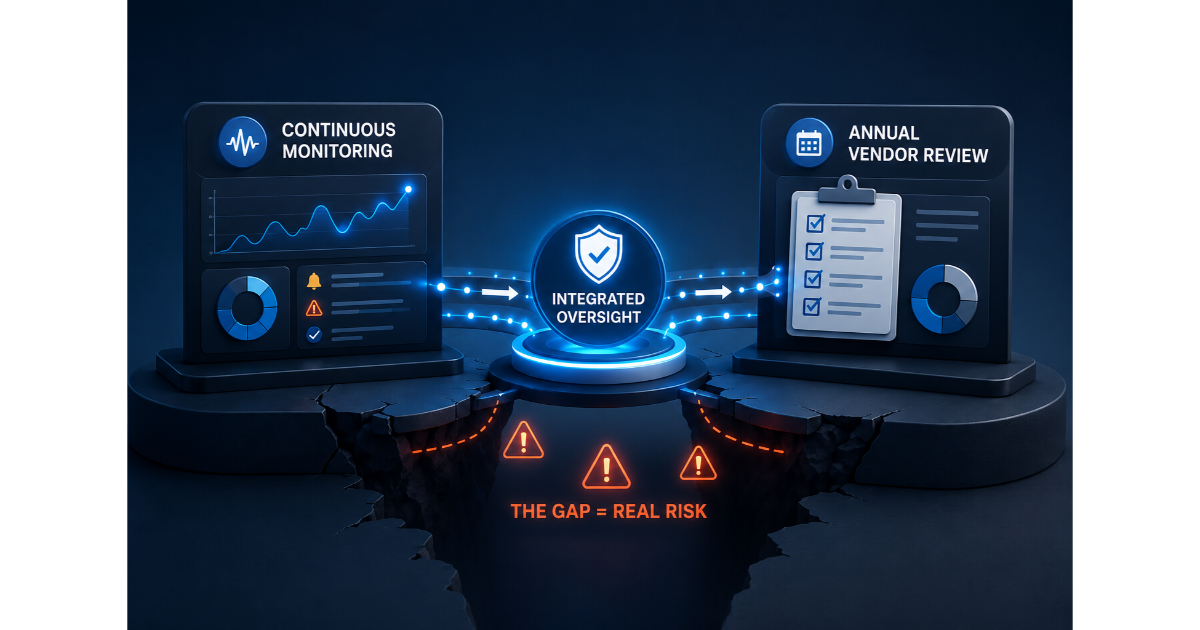
Detection for this category requires continuous vendor monitoring rather than point-in-time assessments, since the risk originates outside the organization's own systems and can change between scheduled review cycles.
How ComplyScore® Monitors Each Risk Type Continuously
ComplyScore® tracks these categories as distinct monitoring domains rather than a single combined risk score, so an IT change management gap and a vendor's financial distress surface as separately owned issues with their own escalation paths. Continuous monitoring pulls signals across cyber, financial, and operational domains in real time, closing the gap between scheduled assessments where incidents like the CrowdStrike outage would otherwise go undetected until the next review.
Because inherent and residual risk scores are tracked separately for each category, risk teams can see which type of operational risk is actually improving after remediation and which is not, instead of one blended score that obscures the difference.
One more thing worth deciding before this goes live: do you want the $500M Delta figure caveated? Delta's own later SEC filing (August 2024) revised the lost-revenue figure down to $380M, with the $500M being the CEO's earlier all-in estimate including compensation and hotel costs — both are real numbers but they're not measuring the same thing. Your draft's "$500 million in losses" is defensible as stated but a sharp reader who's followed the story could flag it as the higher of two figures.
See how ComplyScore® monitors every operational risk type continuously. Book a demo.








.webp?width=387&height=387&name=headless-tprm%20(1).webp)










































%20(1).jpg)