























Best 10 Vendor Management Tools in 2026 - Reviewed by Experts

22 min read | Last Updated: 30 Aug, 2026
TL;DR
- 60% breaches third-party linked: Ponemon research shows 60% data breaches involve vendor vulnerabilities; manual assessments, inconsistent policies, lack real-time insights create significant exposure.
- 10 platforms compared: ComplyScore® leads with AI-powered risk scoring, automated workflows; competitors include Panorays, UpGuard, Venminder, OneTrust, SAP Fieldglass, ServiceNow, Archer, SecurityScorecard, Black Kite.
- Six essential features: Centralized vendor database, compliance tracking, performance monitoring, contract management with renewal reminders, risk assessment analyzing threats, data security with role-based permissions.
- Five selection factors: Align with business needs, ensure scalability for growth, verify integration capabilities with existing systems, prioritize ease of use, evaluate cost versus long-term ROI.
Most organizations work with multiple vendors, from cloud providers to device manufacturers, and that exposure is growing faster than most risk programs can track it. Breaches with third-party involvement have increased by 60% year over year, now reaching 48% of all breaches, according to Verizon's 2026 Data Breach Investigations Report. One weak link, like a third-party data breach, can lead to regulatory fines, operational disruptions, and reputational damage. Managing vendors gets difficult fast if you're running manual vendor assessments, working with inconsistent security policies, and operating without real-time risk insights.
Vendor management software addresses this by automating risk assessments, monitoring compliance, and surfacing actionable insights instead of relying on point-in-time reviews. To help your organization find the right fit, we evaluated the top vendor management tools based on features like security, automation, ease of use, scalability, and compliance capabilities.
We evaluated platforms on how well they adapt to shifting requirements, including DORA, NIS2, India's DPDP Act, UK GDPR, and FCA outsourcing and third-party risk expectations, alongside US requirements like the SEC cybersecurity disclosure rules, NYDFS cybersecurity regulation, OCC and FFIEC third-party risk guidance for banks, and sector-specific mandates such as HIPAA and GLBA. For organizations operating across Southeast Asia, we also looked at fit with MAS Technology Risk Management Guidelines and Singapore's PDPA. We assessed whether each platform delivers measurable outcomes across the full third-party risk lifecycle, and whether it scales as your vendor list grows without forcing you to add headcount just to keep up.
What is Vendor Management Software?
Vendor management software is a tool that helps businesses monitor their suppliers, contracts, and their performance metrics to ensure compliance and identify potential risks. Most companies contracting with multiple vendors rely on traditional tools like spreadsheets and emails to manage all operations revolving around them. In the event of a supply chain attack, business comes to a standstill.
The importance of vendor management software
Vendor management software gives you visibility into your vendor’s security practices. It helps you ensure they enforce cybersecurity compliance and monitor their security policies in real time. The software sends alerts about potential vulnerabilities and puts you in control of your cybersecurity.
Research shows that 60% of data breaches involve vulnerabilities introduced by third-party vendors, so vendor management software with cybersecurity features is critical. It streamlines processes and strengthens vendor relationships, ensuring the integrity and resilience of business operations.
Key features of Effective Vendor Management Tools
Vendor management software with the right features helps businesses optimize vendor relationships, reduce risks, and improve efficiency. It ensures seamless operations and compliance by enhancing communication, scalability, and contract management. Here are the top features to look for in the software.
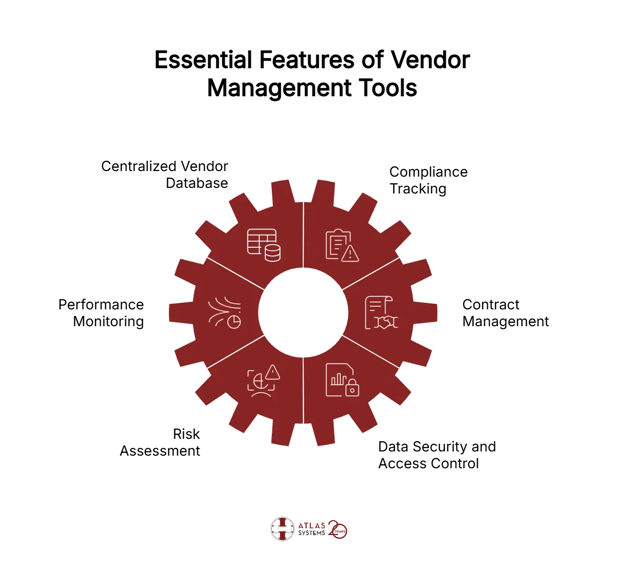
1. Centralized vendor database
The platform should keep all vendor information in one place, such as contracts, contact details, payment terms, and performance metrics. This streamlines vendor management and eliminates scattered records, reducing errors and saving time because users can quickly retrieve and update information.
2. Compliance tracking
A vendor management tool with compliance tracking helps enterprises ensure their vendors follow legal, regulatory, and internal policy standards. They automatically monitor certifications, audit requirements, and contract adherence to avoid legal risks, fines, and reputational damage.
Here is the complete compliance tracking tools list that helps teams centralize monitoring and stay audit-ready.
3. Performance monitoring
This feature helps organizations evaluate and optimize vendor relationships based on data-driven insights. They track key metrics such as quality of service, cost efficiency, delivery times, and responsiveness to identify top performers and address underperformance quickly. This helps align vendor outputs with business goals.
4. Contract management
Good vendor management software enables businesses to systematically organize, track, and enforce contractual agreements. It automates reminders for key things like renewals and expirations, helping companies avoid missed deadlines, unexpected lapses, or unfavorable terms. Vendor contracts are transparent and optimized for mutual success.
5. Risk assessment
A risk assessment feature analyzes factors such as compliance violations, cybersecurity threats, and financial stability to help companies avoid legal issues, prevent disruptions, and maintain smooth operations. Early identification of potential risks allows for proactive mitigation strategies.
6.Data security and access control
Vendors often handle critical business data, so the software you choose should have role-based permissions and encryption protocols to ensure that only authorized personnel can access specific information. This decreases the likelihood of data leaks, cyberattacks, and compliance violations. Confidential documents like contracts, financial records, and performance metrics remain secure.
Types of Vendor Management Software (Which One Do You Actually Need)
Not every tool sold as "vendor management software" solves the same problem, and the category name won't tell you which one you need. Four types show up most often:
Risk and compliance-focused platforms center on vendor security posture, regulatory adherence, and continuous monitoring, built for organizations where a vendor failure means an audit finding or a breach, not just a late delivery.
ERP-embedded vendor modules live inside your existing financial system, so vendor records, purchasing, and payments share one dataset instead of syncing across tools.
Procurement and spend-management platforms center on request-to-PO workflows, budget control, and approval routing, built for finance and procurement teams managing purchasing volume more than vendor risk.
Contingent workforce VMS platforms manage staffing vendors, contractor onboarding, and timecards specifically, a different problem from managing suppliers or service vendors.
Most vendor management searches assume there's one right answer. There isn't. The right category depends on whether your actual pain is risk exposure, purchasing chaos, or contractor sprawl.
Benefits of Vendor Management Tools
A good vendor management tool improves efficiency and reduces risks. It enhances vendor relationships and supports business scalability. Here are the top benefits of the software:
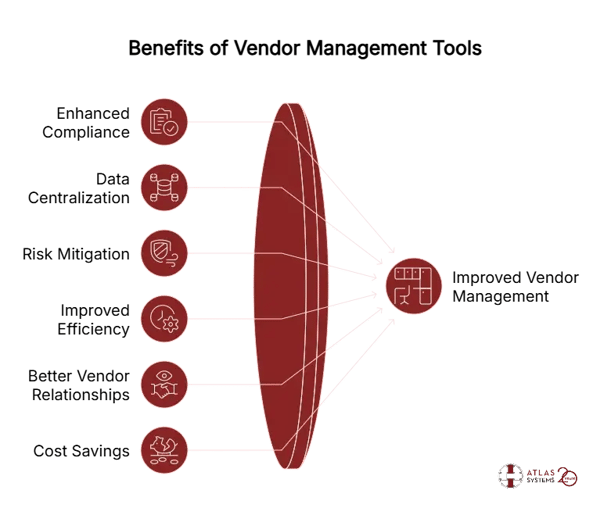
- Enhanced compliance: The software automates the tracking and managing of vendor certifications and regulatory requirements. Vendors consistently meet legal and industry-specific guidelines.
- Data centralization: All vendor-related information is consolidated into a single, secure repository, which eliminates silos and manual data handling. Everyone has access to the same up-to-date information
- Risk mitigation: The tool continuously monitors vendor compliance, security posture, and performance to identify vulnerabilities and take corrective action. Real-time alerts ensure vendors meet security and regulatory standards
- Improves efficiency: Automated processes, streamlined workflows, and a centralized data repository enhance vendor onboarding, contract management, and performance tracking, saving time and resources
- Better vendor relationships: The software fosters transparency, streamlines communication, and improves collaboration. Vendors stay updated about expectations, performance metrics, and payment statuses
- Cost savings: A vendor management tool reduces business costs by automating routine tasks and reducing manual processes
The Best Vendor Management Software Platforms at a Glance
|
Name |
Best for |
Standout feature |
Pricing |
|
Medium and large organizations that want to manage third-party risk, monitor compliance, and perform vendor governance |
Real-time risk monitoring for proactive identification and mitigation of threats |
Customized pricing |
|
|
Panorays |
Businesses that want to automate and enhance third-party cybersecurity risk management |
External security assessment that offers a comprehensive security view without requiring vendor installation |
Customized pricing |
|
UpGuard Vendor Risk |
Organizations that prioritize third-party risk management and prevention of data breaches |
The tool’s cybersecurity ratings system provides a clear view of a vendor’s security posture |
Starts at $1,599 per month for the basic plan |
|
Venminder |
Businesses focused on third-party risk management that want to manage the entire vendor lifecycle efficiently |
Customizable risk assessment questionnaires help enterprises create evaluations based on specific risk factors |
Customized pricing |
|
OneTrust Third-Party Management |
Automating third-party risk management, ensuring compliance, and reducing exposure to cyber risks |
Integrates with 50 built-in control frameworks, ensuring organizations comply with industry standards seamlessly |
Customized pricing |
|
SAP Fieldglass |
Organizations managing complex third-party risks in highly regulated industries like finance and healthcare |
Offers pre-completed assessments for over 70,000 vendors, which significantly reduces the assessment time |
Customized pricing |
|
ServiceNow Vendor Risk Management |
Large organizations managing complex vendor relationships and third-party risks across various operations |
Integrates with ServiceNow’s ITSM and GRC platforms to provide a unified view of vendor workflows and risks |
Customized pricing |
|
Archer |
Businesses in highly regulated industries seeking robust third-party risk management and compliance oversight |
The Archer Engage for Vendors feature enhances collaboration with vendors for information sharing and better assessment |
Customized pricing |
|
SecurityScorecard |
Businesses that want to create a secure vendor ecosystem by continuously monitoring and managing third-party risks |
Instant cyber risk ratings based on vendor cybersecurity questionnaire responses reveal vendor security postures |
Customized pricing |
|
Black Kite |
Organizations seeking comprehensive third-party risk intelligence to manage and mitigate cyber risks proactively |
Offers risk assessments to analyze a supply chain's security posture from three key points: technical, financial, and compliance |
Customized pricing |
Vendor Management Tools - Reviewed by Industry Experts
These vendor management tools have been reviewed by industry experts who use them in their day-to-day work. Based on their hands-on experience and insights, we’ve shortlisted and segmented these tools to help you identify the right solution.
1. ComplyScore® by Atlas Systems
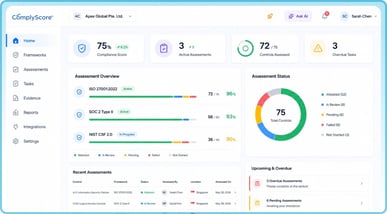
ComplyScore® is very popular for vendor management software among companies in highly regulated industries like healthcare, finance, and retail. In these industries, regulatory compliance and vendor security are critical, and ComplyScore® simplifies compliance, due diligence, and risk-scoring processes.
Key features
- AI-powered risk scoring: Uses customizable criteria such as cybersecurity posture, compliance adherence, and financial stability for holistic risk visibility
- Vendor governance framework: Automated workflows and performance tracking simplify vendor management
- Incident response management: Machine learning algorithms automate incident detection and response
- Regulatory compliance monitoring: Helps enterprises align with domestic and international standards by using AI to assess vendor security and monitor compliance
- Proactive risk mitigation: AI, automation, and advanced analytics help organizations identify potential vulnerabilities early and apply measures to mitigate risks
Pros
- Aligns with global regulations: The software adapts to laws and regulations across the globe and is used by organizations in over 65 countries
- Focused on regulatory compliance: It’s built for industries with strict compliance requirements and significantly reduces the burden of manual audits
- Scalable: Customizable dashboards and automated workflows make it ideal for both small and large businesses
- AI-driven compliance automation: Helps organizations streamline regulatory adherence by continuously monitoring and updating compliance requirements.
- Good customer support: The super responsive support team streamlines troubleshooting and training
Cons
- Learning curve for advanced features: Users new to third-party risk management software may need time to utilize the advanced features fully
2. Panorays
This vendor management tool helps organizations assess, manage, and continuously monitor their vendors’ cybersecurity posture. It leverages automated security assessments and real-time threat intelligence to give businesses a comprehensive view of third-party risks.
Key features
- Continuous monitoring: Panorays monitors the security posture of third parties 24/7 and alerts users on new vulnerabilities, non-compliance, or breaches
- Automated security questionnaires: Customized questionnaires streamline vendor onboarding and reduce manual effort
- Dynamic risk scoring: The Risk DNA feature offers real-time risk ratings based on vendor questionnaire responses, external threat intelligence, and technical scans
Pros
- Vendor collaboration portal: This streamlines the assessment process by facilitating communication and evidence collection
- Real-time alerts: The platform provides real-time visibility into third-party cyber risks and offers instant alerts for proactive threat response
- Pre-built templates support compliance frameworks: These ensure regulatory adherence to key compliance standards like GDPR, ISO 27001, CCPA
Cons
- Limited technical scans: The platform doesn’t perform deeper penetration testing for high-risk vendors
- Focused on cyber risk coverage: Panorays doesn’t focus on other types of vendor risks, such as operational resilience or financial stability
- Steep learning curve: New users may have difficulty customizing workflows or interpreting AI-powered insights
3. UpGuard Vendor Risk
Organizations use this comprehensive vendor management platform to assess, monitor, and mitigate vendor risks. UpGuard provides tools for identifying vulnerabilities, monitoring data breaches, and ensuring compliance. It’s widely used in industries where evaluating third-party regulatory compliance and security is vital.
Key features
- Data breach detection: Sends users alerts if their sensitive data appears in public data leaks or on the dark web
- Automated risk assessments: The platform uses AI to analyze vendor information and identify potential risks for more accurate assessments
- Continuous vendor monitoring: UpGuard continuously scans and monitors vendors' security postures for updated risk assessments
Pros
- Scalable: The platform integrates with ServiceNow and RSA Archer and supports unlimited vendors, helping companies to scale with ease
- Security ratings: These offer a standardized, data-backed way to compare vendor risk levels
- Risk remediation workflows: Guided workflows help vendors remediate potential risks
Cons
- Initial setup can be complex: Extensive customization options can make the initial setup process complex for some users
- Occasional delays in data updates: These can affect the accuracy of risk assessments in some cases
- Costly for smaller organizations: The software can be expensive, especially for smaller businesses or those with limited budgets
4. Venminder
Venminder helps organizations manage the entire vendor lifecycle, from onboarding to offboarding. It is a comprehensive tool for vendor governance as it focuses on compliance management, risk assessments, and due diligence processes.
Key features
- Venminder Exchange: Businesses can purchase previously conducted vendor risk assessments to speed up the assessment process
- Continuous monitoring with Venmonitor™: The feature monitors vendor risks in real-time, helping enterprises stay updated with changing vendor risk postures
- Vendor lifecycle management: Dedicated features for vendor onboarding, offboarding, and ongoing management provide a structured approach to vendor governance
Pros
- Customizable templates for risk assessment: These align with frameworks like NIST and ISO for inherent and residual risk scoring
- Comprehensive features: These ensure alignment with regulatory standards like GDPR or NY DFS
Cons
- Over-reliance on vendor data: Venminder relies on the accuracy of vendor-provided data to be effective
- Setup can be complex: New users may need significant time and resources the implement the vendor management solution
- Features can be overwhelming for small businesses: Smaller companies with only a few vendors don’t need all the features
5. OneTrust
Small and large companies use OneTrust Third-Party Risk Management to assess, monitor, and mitigate risks associated with third-party vendors. The platform integrates with privacy, security, and governance tools to help organizations manage vendor relationships across various industries.
Key features
- Automated risk assessments: OneTrust automates the analysis of risk assessments to ensure consistent evaluations and reduce manual effort
- Vendor repository: All vendor-related information is contained in one spot for efficient data management and retrieval
- Regulatory compliance tracking: The platform tracks regulatory requirements in various industries to ensure vendors comply with them
Pros
- Seamless integrations: OneTrust Third-Party Risk Management integrates with other OneTrust modules for enhanced security and compliance management
- Vast knowledge base: Free webinars, whitepapers, and guides support continuous learning
- AI-driven insights: Uses AI to analyze vendor data, spot trends, and predict potential risks before they escalate
Cons
- Integration limitations: Some users have reported that OneTrust doesn’t integrate well with some non-standard applications, and technical support may be required
- Complex setup: The software’s extensive features and customization options can make the initial setup process challenging
- Reliance on vendor participation: Vendors must actively participate in the onboarding process, which may be challenging if they are unresponsive or lack resources
6. SAP Fieldglass
This cloud-based vendor management company helps organizations efficiently onboard, manage, and offboard vendors while ensuring compliance and cost optimization. Global enterprises that rely heavily on external talent and services use it to streamline workforce operations and improve procurement efficiency.
Key features
- Vendor management: The platform promotes stronger supplier relationships through performance tracking and contract management
- Compliance management: Automates compliance tracking to ensure adherence to industry laws and internal policies to mitigate potential risks
- Facilitates service procurement: Provides tools for managing contracts and SOWs (Statements of Work) to facilitate the procurement of outsourced services
Pros
- Powerful integrations: Seamlessly integrates with most third-party systems to streamline operations across different business functions
- Extensive feature set: The tool has multiple features that support vendor management
- Simplifies data management: Data handling and management is easy thanks to data import and export processes that facilitate smooth reporting
Cons
- Mobile app challenges: The mobile app doesn’t work as well as the desktop version
- Integration limitations: Some users say they encounter difficulties when connecting the software with their business systems
- Complex for new users: The vendor management platform can be complex to use initially
7. ServiceNow Vendor Risk Management
ServiceNow Vendor Risk Management helps businesses streamline and automate the assessment and mitigation of risks associated with third-party vendors. By continuously monitoring and managing vendor-related risks, organizations can ensure compliance and operational resilience.
Key features
- Vendor portal: This promotes collaboration between the organization and vendors, streamlining information submission and assessments
- Automated risk assessments: Automated risk assessments and customizable questionnaires streamline the due diligence process
- Powerful reports and analytics: These help enterprises to track vendor risk and performance and support data-driven decision-making
Pros
- Integrated risk management: Businesses can correlate vendor risks with other business risks for a holistic view of risk
- Vendor tiering: Organizations can classify vendors according to risk levels, allowing them to prioritize resources
- Continuous monitoring: Tracks vendor performance and compliance in real time for proactive risk identification and mitigation
Cons
- Occasional performance issues: Some users report occasional system slowdowns when handling large datasets.
- Complex setup: Users new to the ServiceNow platform may find implementation complex
- Customization can be hard: New users say that advanced customization requires some expertise
8. Archer
Part of the RSA Archer Suite, this vendor management software offers a comprehensive solution for managing the entire vendor lifecycle. The platform suits companies with complex vendor ecosystems because it focuses on risk assessment, compliance management, and continuous monitoring.
Key features
- Centralized vendor repository: The comprehensive vendor database helps enterprises to track and manage vendor information efficiently
- Customizable dashboards and reporting tools: These provide insights into vendor risks and performance metrics
- Risk scoring: Uses predefined criteria to assign risk scores to vendors and continuously monitors them to identify changes in risk posture
Pros
- Integrates with contract management systems: This helps with tracking vendor contracts and obligations
- Intuitive dashboards: These showcase operational risk and eGRC capabilities, providing an advanced overview of risk and compliance posture
- Regulatory compliance: Aligns with compliance frameworks like GDPR, ISO 27001, and NIST for audit readiness
Cons
- Complex user interface: Some users say the platform has a learning curve because of the numerous drop-downs and buttons
- Focus on financial services: Archer VRM focuses on financial institutions and its pre-built workflows and templates align with banking regulations like OCC and FFIEC
- Limited plug-and-play features: The platform may require configuration for specific use cases
9. SecurityScorecard
SecurityScorecard provides visibility into vendor ecosystems, allowing businesses to prioritize high-risk vendors and proactively address vulnerabilities. It has a proprietary scoring methodology for evaluating vendor cybersecurity posture and is a vital tool for compliance, threat intelligence, and vendor collaboration.
Key features
- Security ratings: Data-backed A-F grades offer a clear view of vendor risk levels
- Real-time monitoring: Continuously monitors vendors to identify changes in security posture
- Supply chain threat intelligence: Uses advanced threat intelligence and predictive analytics to identify high-risk third-parties and fourth-parties
Pros
- Third-party collaboration portal: Vendors can view their security ratings and collaborate on remediation efforts
- Comprehensive dashboards: These provide a clear overview of security metrics for informed decision-making
- Focuses on external threats: SecurityScorecard is very good at identifying external-facing risks that are often overlooked by other tools, such as cloud misconfigurations
Cons
- Vendor dependency: The platform heavily relies on automated questionnaires for vendor assessment and is limiting for organizations needing deeper insights
- False positives: Occasional inaccuracies in external scans or security ratings often require manual verification
- Learning curve: New users may find it difficult to use advanced features like predictive analytics
10. Black Kite
This cybersecurity-focused vendor management software provides technical, data-driven cybersecurity ratings of vendors for a more quantifiable view of vendor security risks. It uses advanced automation and open-source intelligence to uncover vulnerabilities across supply chains.
Key features
- Nth-party risk monitoring: Assesses fourth, fifth, and even sixth parties to identify vulnerabilities in supply chains
- Cloud asset mapping: Analyzes vendor cloud infrastructure to spot risks in multi-cloud environments
- Ransomware Susceptibility Index®: This tool assesses the likelihood of ransomware attacks on vendors for proactive risk mitigation
Pros
- Actionable insights: The financial quantification of risks makes it easier for decision-makers to understand the financial impact of cybersecurity threats
- Powerful automations: Automated workflows and compliance mapping tools reduce the assessment time from weeks to hours
- FocusTags™ for threat intelligence: Tracks high-profile cyber events and flags affected vendors in real-time for quick action
Cons
- Complex setup: Configuring workflows and integrating the software with existing business systems may require significant effort
- OSINT (Open Source Intelligence) reliance: Black Kite relies heavily on OSINT, which can affect the accuracy and completeness of data
- Costly: Some advanced features like Nth-party monitoring are very costly for smaller organizations
What Does Vendor Management Software Cost?
Vendor management software pricing can range from a few hundred dollars per month to six figures annually, depending on the number of vendors, users, integrations, risk and compliance features, and deployment model. Typical ranges look like this:
- Basic vendor management: $50 to $500 per month
- Mid-market platforms: $5,000 to $30,000 per year
- Enterprise vendor risk management (VRM/TPRM): $30,000 to $150,000+ per year
- Large enterprise deployments: $150,000+ annually, especially with extensive integrations, custom workflows, and implementation services
For a TPRM-focused product like ComplyScore®, pricing is usually driven more by vendor volume, risk assessment requirements, monitoring depth, automation, and integrations than by the number of software users alone.
Questions to Ask Before You Choose a Vendor Management System
Beyond the standard feature checklist, a few direct questions expose the gaps that don't show up in a demo:
- Does the tool extend past onboarding into continuous vendor monitoring, or does oversight stop once the contract is signed?
- Can someone on your team own configuration after go-live, or does every change require vendor professional services?
- Does pricing scale predictably with vendor count, or does it jump at specific thresholds you'll hit within a year?
- If a vendor's risk profile changes after onboarding, how does the platform surface that, and how fast?
Try ComplyScore® - Best Vendor Management Platform
Are you drowning in spreadsheets, juggling multiple vendors, and constantly chasing compliance deadlines? Manual processes can significantly reduce your organization’s productivity. ComplyScore® by Atlas Systems simplifies vendor management by streamlining workflows and ensuring compliance.
ComplyScore® helps you take control of your vendor ecosystem with precision so you can focus on growing your business. With powerful automation tools, top-notch security, and seamless integrations, ComplyScore® is your partner in vendor governance. Make vendor management effortless; contact us to discuss how our software can transform your operations.
FAQs about Vendor Management Software Platforms
1. How do I choose the right vendor management software for my business size?
To choose the right software, focus on the key features. If you run a small business, you need a tool for vendor tracking and contract management. A mid-sized business will need features like compliance tracking, risk assessment, and automation, while a large company will need real-time monitoring, AI-driven analytics, and integrations with procurement and security systems.
2. Are there vendor management solutions specifically built for small businesses?
Yes, some vendor management tools cater specifically to small businesses. Their key features include vendor onboarding, payment processing, contract tracking, and performance monitoring.
3. Should startups invest in paid vendor management software?
Yes, getting paid vendor management software is an investment that pays off in efficiency, security, and peace of mind. Every dollar and decision counts for startups, and the software automates key processes and even flags potential risks before they become costly mistakes.
4. Can vendor management software handle contracts and compliance tracking?
Yes, with vendor management software, you’ll never have to scramble to find a contract or fail to comply with industry laws and regulations. You’ll easily manage contracts and avoid non-compliance thanks to automatic reminders for contract renewals and alerts for compliance risks.
5. What is a vendor management system?
A vendor management system centralizes vendor data, contracts, performance tracking, and compliance monitoring in one platform, replacing scattered spreadsheets and email threads with a single source of truth for every vendor relationship.
Author
Nasir R
Nasir is a marketing professional who creates content that simplifies complex topics like third-party risk management, compliance, and vendor governance. Through blogs, e-books, and best-practice guides, he shares practical insights to help organizations strengthen their risk posture and build long-term resilience.