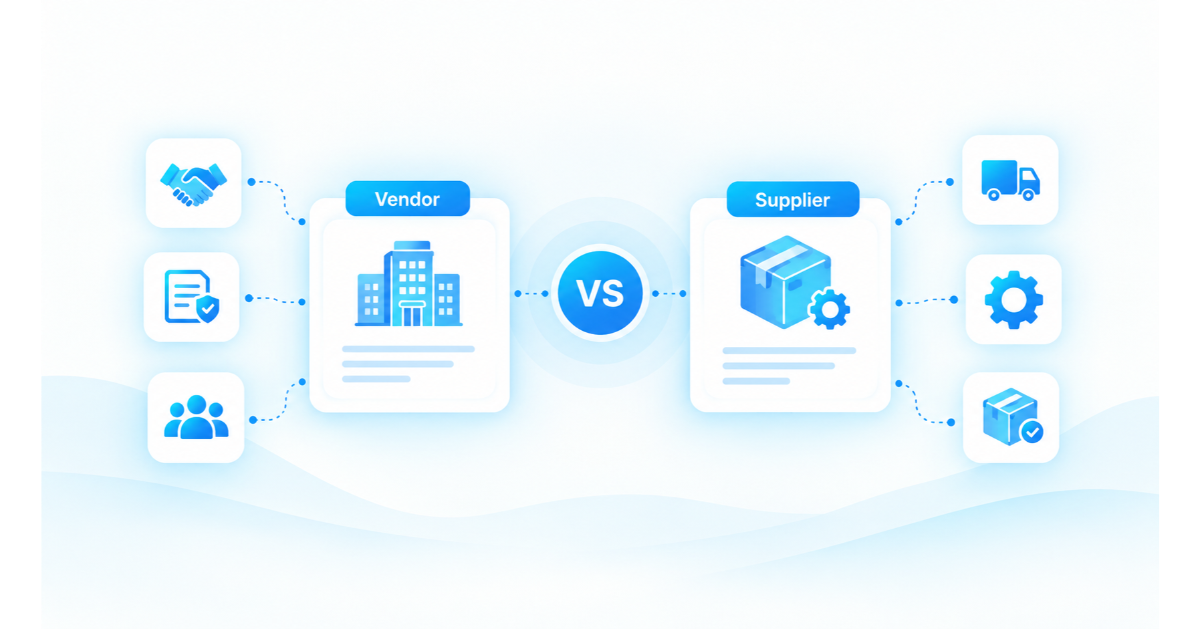
A supplier provides raw materials or components that go into something else you sell or build. A vendor sells a finished product or service directly to you, the buyer. The distinction comes from procurement, but once you're building a risk program around either one, the label matters less than what you'd expect.
What is a supplier?
A supplier sits upstream in the chain. They provide the parts, materials, or inputs another business turns into a finished product. A steel supplier feeding a manufacturing line, a packaging supplier feeding a consumer goods company, a textile supplier feeding a garment maker. Almost all supplier relationships run business to business. The supplier rarely, if ever, deals with your end customer directly.
What is a vendor?
A vendor sells you something finished. A software subscription, a managed service, office equipment, a cloud platform. Vendors can sell to other businesses or straight to consumers. Where a supplier's work disappears into your product, a vendor's product or service arrives ready to use.
Vendor vs. supplier: the differences at a glance
| |
Supplier
|
Vendor
|
|
Position in the chain
|
Upstream, feeds into production
|
Downstream, delivers the finished item
|
|
Relationship type
|
Almost always B2B
|
B2B or B2C
|
|
What they deliver
|
Raw materials, components, parts
|
Finished products or services
|
|
Typical example
|
A steel supplier for a manufacturer
|
A SaaS company selling a subscription
|
Most confusion starts because accounting software and ERPs collapse both into a single "vendor" record, since both get paid through the same accounts payable process. That's fine for finance. It gets messier once a risk team needs to know who actually has access to what.
Does the distinction actually matter for a risk program?
Less than the label suggests. What actually determines how much scrutiny a partner needs is data access and business criticality, not whether they're technically upstream or downstream. A raw-material supplier who never touches your systems or customer data carries a different risk profile than a SaaS vendor with admin access to your CRM, regardless of which word sits on their invoice.
That said, the words still show up in policy documents, contracts, and internal systems, and inconsistent usage there creates real confusion. If your vendor management policy only defines "vendor," a supplier relationship can slip through vendor onboarding checks nobody realized should have applied to them.
How ComplyScore® Runs Vendor and Supplier Risk as One Program
The practical fix most organizations land on: define "vendor" broadly enough in policy to cover both, and let actual risk tiering, based on data access and criticality, decide how deep the assessment goes.
Where this breaks down in practice is systems, not policy. Procurement's ERP tags a record one way, IT's asset inventory tags it another, and nobody's reconciling the two into a single risk picture. The same exposure gets assessed twice under different names, or missed entirely because it's sitting in a system your risk team doesn't check.
ComplyScore® removes that reconciliation work instead of asking you to do it by hand. You can tag a record as vendor or supplier for internal tracking and reporting, while the platform runs the same risk tiering, assessment, and continuous monitoring workflow underneath regardless of which label it carries. Reports stay accurate for whoever's pulling them by department, without two parallel processes someone has to keep in sync manually.
If your vendor and supplier records currently live in separate spreadsheets or separate systems, book a demo to see how ComplyScore® brings supplier risk management and vendor risk under one view.



.png?width=200&height=45&name=ComplyScore%20Logo%20Transparent%20(1).png)


.webp?width=869&height=597&name=image%20(5).webp)


-1.png?width=486&height=315&name=IDC%20Banner%20(1)-1.png)



.png?width=300&height=175&name=Rectangle%2034624433%20(2).png)


.webp?width=1280&height=720&name=Medtech%20Breakthrough%20Award%20Winner%20(1).webp)














%20(1).jpg)