In 2024, insurers denied 19% of in-network claims, with administrative issues accounting for a quarter of those denials, according to KFF. A 2025 Experian Health survey also found that half of revenue cycle leaders identified missing or inaccurate data as a leading cause of claim denials.
One common cause is incorrect provider data. A provider's NPI, practice location, enrollment dates, or network status may not match the information a health plan has on file. Even a small mismatch can lead to a denied claim, delayed payment, and extra work for both providers and payers.
The problem often starts long before a claim is submitted. Outdated rosters, delayed updates, and incomplete enrollment records can all create errors. Understanding where these errors begin and how to catch them early can help organizations avoid preventable claim denials.
How Do Provider Data Errors Cause Claim Denials?
A claim is denied for a provider data error when details on the claim, such as the rendering NPI, service location, taxonomy, network status, or enrollment dates, do not match what the payer holds on file for that provider on the date of service. The fix usually sits upstream, in rosters and enrollment records.
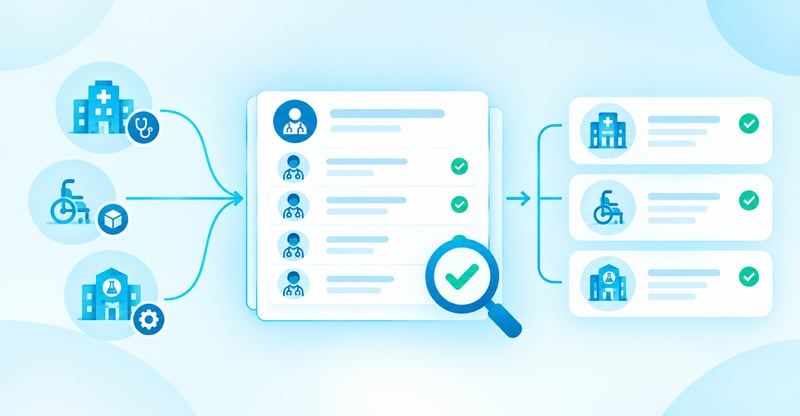
Claims adjudication compares what the provider submits against the payer's provider file, and that file is built from rosters, enrollment applications, credentialing outcomes, and contract loads. If a provider moved, joined a group, or added a location and the change reached the payer late or incompletely, the adjudication system has no way to know the claim is valid.
Which Provider Data Errors Most Often Trigger Denials?
The same handful of mismatches drives most provider data denials, and each tends to come back with a recognizable remittance code. Codes vary by payer, so treat these as common patterns rather than fixed rules.
|
Provider data error
|
Where it usually starts
|
What the remittance often shows
|
|
Date of service falls outside the provider's enrollment effective or termination date
|
Enrollment approved late, or a termination applied to the wrong date
|
CARC B7: provider not certified or eligible on this date of service
|
|
Rendering provider not loaded to the member's plan product
|
Partial product load, or a specialty mismatch in the payer file
|
CARC 185: rendering provider not eligible to perform the service billed
|
|
Missing or invalid rendering provider identifier
|
NPI or group setup that differs between billing system and payer file
|
CARC 16 with RARC N290
|
|
Provider appears out of network
|
Roster not loaded, or affiliation to the contracted group missing
|
CARC 242: services not provided by network providers
|
|
Ordering or referring provider not enrolled
|
Clinician never enrolled in Medicare PECOS or the state Medicaid program
|
Ordering and referring edits that deny the claim
|
|
New practice location missing from the payer file
|
Location added internally but never sent on a roster
|
Payer-specific location or network edits
|
The ordering and referring row catches many groups by surprise. Medicare denies claims for services ordered or referred by a clinician who is not enrolled in PECOS, and federal Medicaid rules at 42 CFR 455.410 require ordering and referring providers to be enrolled with the state program.
Why Do These Errors Keep Coming Back?
Most organizations fix individual denials well and still see the same error next month, because the cause sits in how provider data moves between organizations. The four patterns below account for most repeat denials.
Provider data lives in several systems
A health system may hold provider data in a credentialing system, a practice management system, an EHR, and a payer enrollment tracker, each with its own version of addresses, taxonomy codes, and group affiliations. A change made in one system rarely reaches the others on the same day, so the record a roster pulls from may already be out of date.
Updates reach some payers and not others
A provider group that bills twenty or more plans sends the same change in twenty formats, through portals, spreadsheets, and attestation requests. Consider a group that adds a new clinic and updates its largest payers within a week, while three smaller plans receive the change a month later. Claims from that clinic will pay with some payers and deny with others, and the pattern is easy to misread as a payer-specific problem.
Payer-side changes happen without notice
Provider files also change on the payer side. Teams describe providers loaded to most of a plan's products but not all of them, enrollments that lapse after a payer system migration, and Medicaid disenrollments that surface only when claims start to be denied. Without monitoring, the first sign is a remittance.
Submissions are never confirmed
Many payers do not confirm that a roster was received and loaded. A provider organization that cannot see load status has to assume each update went through until claims prove otherwise.
What Do Provider Data Denials Cost Payers and Providers?
Provider data denials cost both sides, and the cost compounds because the same bad record also feeds the directory.
For provider organizations, each denial means rework, delayed cash, and the risk of write-offs once timely filing limits pass. For payers, the same mismatch produces appeals, provider service calls, and adjustment work, while the inaccurate record behind it may also appear in the member-facing directory, where it creates compliance exposure under CMS and No Surprises Act directory rules.
|
Cost
|
Provider organization
|
Health plan
|
|
Direct rework
|
Correcting records, resubmitting claims, appeals
|
Reprocessing, adjustments, appeal reviews
|
|
Cash and payment timing
|
Delayed collections, possible write-offs
|
Interest and prompt-pay exposure on late payments
|
|
Relationship cost
|
Frustration with payer service channels
|
Provider abrasion and network retention risk
|
|
Compliance exposure
|
Billing under incorrect enrollment data
|
Inaccurate directory listings and audit findings
|
How to Catch Provider Data Errors Before Claims Go Out
Prevention works best when your team treats provider data as part of the revenue cycle, with the same checkpoints you apply to coding and eligibility. These four practices close most of the gaps described above.
Validate rosters at intake
Check every roster row against the master record before it is loaded or sent. Missing NPIs, invalid taxonomy codes, addresses that cannot be standardized, and terminations without a date should stop at intake, where they take minutes to fix, instead of at adjudication, where they cost a claim.
Reconcile against primary sources and payer files on a schedule
Compare your provider records with NPPES, PECOS, state license boards, and each payer's directory or provider file. For provider organizations, this is where you find the partial product loads and silent terminations that no payer will tell you about. Teams that run provider roster reconciliation on a fixed cadence find these gaps before claims do.
Check enrollment dates before scheduling
Before a new provider sees patients under a given plan, confirm that enrollment is effective for that payer and product. A scheduling hold costs far less than a month of B7 denials.
Route denials back to the data owner
Tag each provider data denial to its root cause, such as a roster gap, enrollment date, or location record, and send it to the team that owns that data. When denial work and data correction happen in separate queues, the claim gets fixed and the record does not.
How PRIME® Connects Roster, Enrollment, and Directory Data
PRIME® keeps one effective-dated provider record and connects it to the workflows that create claims risk, so a change made once reaches every roster, enrollment, and directory that depends on it. Atlas reports that organizations using PRIME® have reduced claim denials by up to 95% through better provider data accuracy.
The parts of PRIME® that matter most for denials are:
- Provider-Payer Roster Management: Accepts rosters in any format, maps each submitter's layout once, classifies every row as an add, change, termination, or no change, and returns a reconciliation report so roster quality improves each cycle
- Payer Enrollment: Tracks each application by payer, including receipt, stage, and rejection reason, so effective dates are known before claims go out
- Continuous Monitoring: Watches licenses, sanctions, and other credentialing data between cycles, so a lapse opens a correction before it becomes a denial
- Provider Data Management Engine: Applies source-of-truth rules to each attribute, keeps full history for retroactive claims questions, and syncs changes to claims, contracting, and directory systems
Stopping Provider Data Claim Denials at the Source
Provider data claim denials start in rosters, enrollment records, and payer files that drift apart over weeks, long before a claim is submitted. Treating that data as part of the revenue cycle, with validation at intake, scheduled reconciliation, and denial routing back to data owners, turns a recurring loss into a manageable process.
To see how one record can serve your rosters, enrollments, and directories, explore the PRIME® provider data management platform.