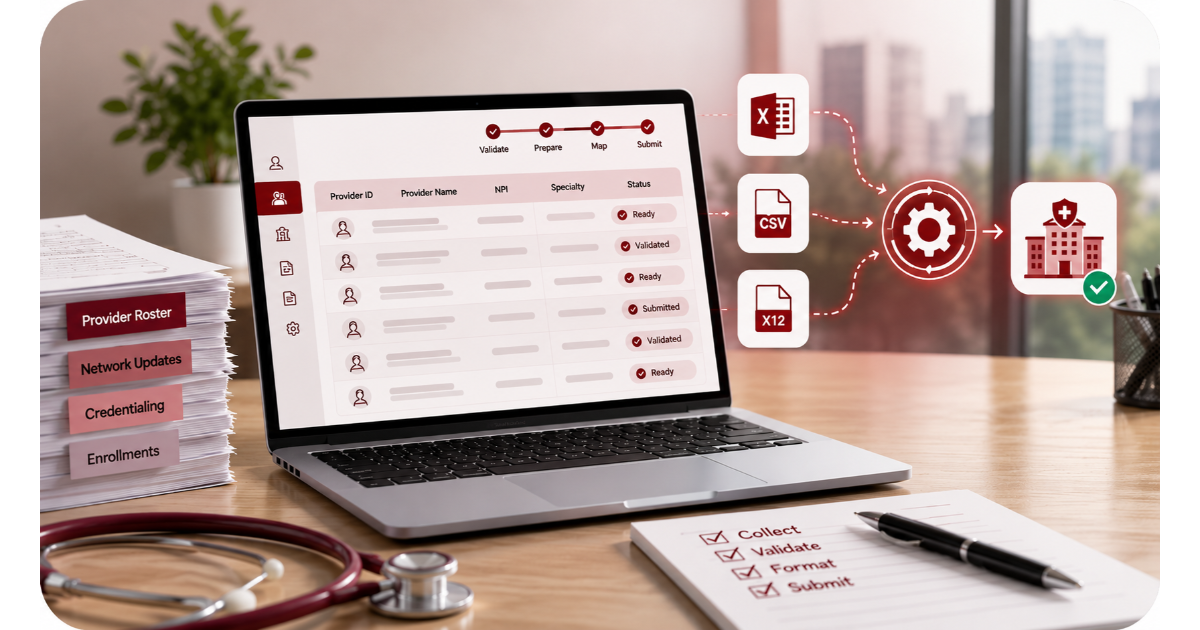
Most healthcare organizations already have the data. A credentialing platform, an EHR, a billing system, a provider directory. What they're missing is a reliable way to move verified data between those systems without someone manually re-entering it at every step.
That gap is where provider data errors actually live. Industry reports estimate that roughly 25% of provider data changes every quarter, meaning any record that isn't actively synced begins decaying almost immediately. The consequences show up as claim denials, directory inaccuracies, enrollment delays, and audit exposure. The systems exist; the integration between them doesn't.
Why the Data Exists But the Problem Persists
Provider data integration connects credentialing, enrollment, directory, and billing systems to a single authoritative source, so a verified change in one system reaches every downstream workflow automatically, without manual intervention.
The difficulty is structural. Each system was built to solve a different problem: credentialing platforms track qualification status, EHRs track clinical encounters, billing systems track reimbursement, enrollment tools track payer participation. None were designed to share data in real time.
The result: the same provider may carry different NPIs, addresses, or enrollment statuses across four systems, and every version looks correct from inside the system holding it. A 2024 AJMC study found that provider data inaccuracies persist in directories for an average of 540 days before correction. That's an integration problem. No system has the authority to tell the others when something changes.
Where the Handoff Actually Breaks Down
Integration typically fails at one of three points in the provider data lifecycle.
Credentialing to enrollment
Credentialing confirms a provider's qualifications. Payer enrollment establishes the billing relationship with each health plan. When these two workflows live in separate platforms, the handoff between them depends on someone manually transferring information.
That gap creates lag, and during that lag, providers may begin seeing patients whose claims cannot yet be submitted.
Roster submission to payer
When a provider organization submits an accurate roster, confirmation that the payer accepted it rarely comes back. Teams submit and assume. They can't see whether the payer processed the file, rejected a row, or updated the record at all.
Without that feedback loop, discrepancies between internal records and payer records quietly compound.
Payer records to provider directory
The provider directory is supposed to reflect who is in-network and accepting patients. In practice, it reflects whatever was last manually pushed to it. When a provider changes locations or leaves a practice group, that update has to travel through multiple systems before reaching the directory, and at each step, it depends on someone noticing and acting.
IDC Research estimates provider data errors cost health plans an average of $2.4 million annually, a figure that reflects what happens when the directory, the claims system, and enrollment records are all working from different versions of the same data.
What "Integrated" Actually Looks Like
A genuinely integrated provider data environment passes one operational test: when a provider's information changes at the source, every downstream system updates without a manual step.
In practice, that means:
- A credentialing status change automatically triggers updates to payer enrollment records and the provider directory
- Roster submissions are validated before reaching the payer, so errors are caught before they become denials
- Payer acknowledgments are captured and reconciled against internal records automatically
- Discrepancies between what the organization holds and what the payer has are visible and actionable, without a manual audit
The Four Systems That Need to Share a Source of Truth
|
System
|
What It Holds
|
What Goes Wrong Without Integration
|
|
Credentialing platform
|
Licenses, certifications, PSV records, expiration dates
|
Enrollment continues after a credential lapses; claims are denied retroactively
|
|
Payer enrollment tool
|
Participation status, effective dates, payer-specific IDs
|
Enrollment isn't triggered until credentialing is manually flagged complete; 60-90 day timelines begin late (CAQH Index, 2023)
|
|
Provider directory
|
Specialty, location, network status, accepting-patients flag
|
Directory reflects stale data because updates aren't pushed from upstream systems
|
|
Billing and claims system
|
NPI, taxonomy code, rendering provider, service location
|
Claims are submitted with data that doesn't match payer enrollment records
|
Each system can be technically functional while collectively producing inaccurate outputs. The failure lives in the connections between them, not inside any one platform.
How to Build the Integration Layer Your Workflows Need
Start with one authoritative source
Before connecting systems, decide which record is the master. For most organizations, the credentialing platform holds the most rigorously verified data and is the logical anchor. Every other system should pull from it, not maintain a parallel version of the same fields.
Map the handoffs before configuring anything
Document where data moves between systems: credentialing to enrollment, enrollment to directory, directory to billing. At each handoff, identify what triggers the transfer and what confirms it completed. Most integration failures happen at handoffs that were assumed to be automatic but were actually manual.
Validate before propagating
An integration layer that moves unvalidated data quickly is worse than no integration at all. Build validation into the sync: format checks, taxonomy code matching, NPI verification against NPPES, active license status confirmation. Data should be verified before it reaches the downstream system, not corrected after a claim is denied.
Close the confirmation loop with payers
Roster submissions need an acknowledgment mechanism. Capture payer responses: file receipt confirmations, accepted and rejected provider rows, effective dates. Surface discrepancies against your internal records automatically. Without this step, your roster submission process has no feedback loop.
Monitor continuously, not on a cycle
The CAQH Index (2023) puts average payer enrollment timelines at 60-90 days. Provider data changes, on average, every 90 days. A quarterly audit cycle is already behind before it starts. Continuous monitoring with automated alerts for license changes, location updates, or payer record divergence is the only approach that keeps pace.
Where Integration Efforts Stall
Treating it as purely an IT project
Organizations that hand the initiative entirely to IT often end up with systems that can exchange data but lack the workflow logic: validation rules, approval sequences, confirmation tracking. Technical connectivity without operational governance produces faster, messier data.
Connecting systems without agreeing on which one wins
Two systems can be fully integrated and still hold conflicting data if there's no rule for which record is authoritative when they disagree. Without that definition, integration creates new conflicts rather than resolving existing ones.
Treating go-live as done
Provider networks change, payer requirements shift, and acquisitions add new systems. An integration architecture that works at launch needs ongoing governance, someone responsible for maintaining mapping logic, monitoring for drift, and updating configurations when requirements change. Organizations that treat integration as a one-time project typically see data quality degrade within 12-18 months.
How PRIME® Connects the Workflow
PRIME® by Atlas Systems treats provider data integration as a workflow problem, not just a connectivity one. Its Provider Data Management Engine serves as the single source of truth, connecting credentialing, payer enrollment, directory validation, and roster reconciliation in one unified platform.
When a credential updates in PRIME®, the change propagates to enrollment workflows, directory validation, and roster submissions automatically. Validation checks run before data reaches any payer system. Payer acknowledgments are captured and reconciled against internal records so teams can see which providers are confirmed billable and where gaps exist.
Continuous Monitoring flags changes to license status, DEA registration, or primary source verification records the moment they occur, before they surface as claim denials or audit findings.
To see how PRIME® handles provider data integration across your payer mix and network, schedule a no-cost, no-obligation consultation with our team.
Get a Demo Today.









.webp?width=387&height=387&name=Medtech%20Breakthrough%20Award%20Winner%20(1).webp)





























%20(1).jpg)