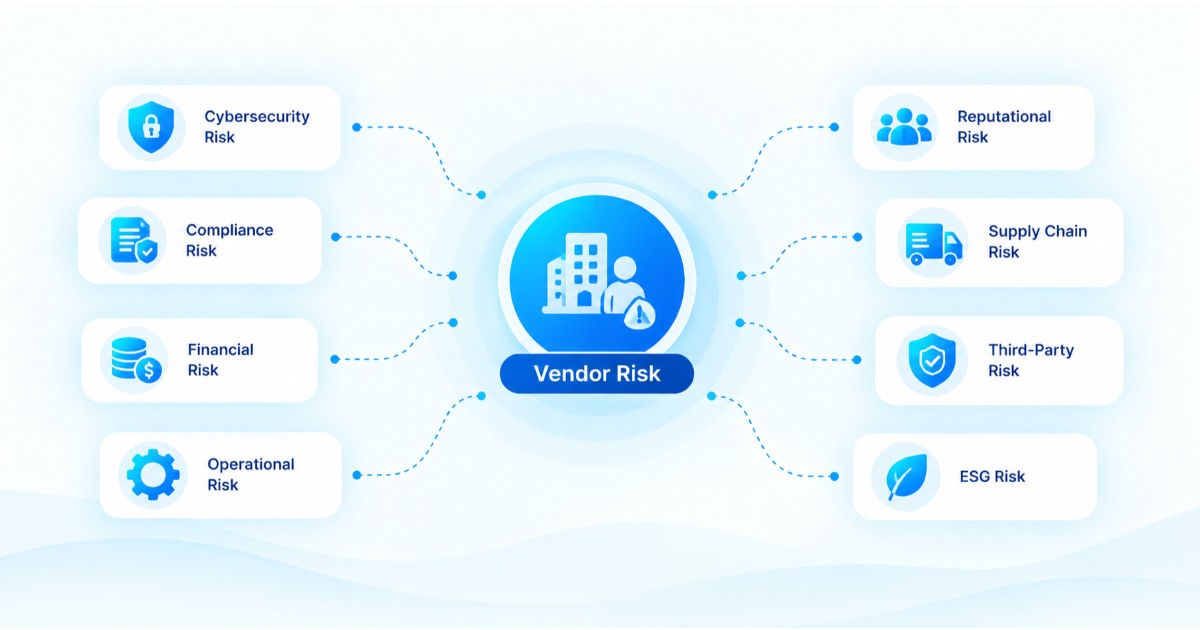
Treating vendor risk as one general category is how specific risks get missed. A vendor with a spotless financial record can still be a cybersecurity liability. A vendor with excellent security practices can still be a compliance problem if they're not licensed to operate in your industry. Knowing which type of risk you're actually looking at determines what you check, how often, and who on your team should be looking.
Most vendor assessments try to cover all of this at once with a single questionnaire and a single risk score. That's usually where nuance gets lost. A vendor can score "medium risk" overall while carrying a serious, specific exposure in one category that a blended score quietly averages away.
1. Financial Risk
A vendor's financial instability threatens their ability to keep delivering, regardless of how good their product or service is. Here's a scenario, not a specific case: a logistics company's key packaging supplier misses two consecutive loan payments. Nobody notices, because the only financial check happened at onboarding two years earlier. Six months later, the supplier stops fulfilling orders entirely, and the logistics company is left scrambling for a replacement mid-quarter, with no warning that would have given them time to plan.
What to check: credit ratings for critical vendors, payment history if visible, and for vendors central to your operations, actual financial statement reviews rather than a self-reported attestation. Monitoring services that flag public financial distress signals, layoffs, missed payments, credit downgrades, catch what a one-time check at onboarding never will.
2. Operational Risk
This covers a vendor's own operational failures disrupting your business: production delays, staffing shortages, system outages, capacity problems. A vendor can be financially healthy and still miss deadlines because of a labor shortage, a facility issue, or simply taking on more clients than they can service well.
What to check: SLA history if you have access to it, capacity relative to how much of their business you represent, and for manufacturing or logistics vendors specifically, whether they have a documented business continuity plan for their own operational disruptions.
3. Cybersecurity Risk
A vendor's security gaps become an entry point into your own systems or data. This is often the category that draws the most attention, and for good reason, since the damage can be immediate and severe. Picture an accounting software vendor where an employee reuses a compromised password on the vendor's admin panel, giving an attacker access to every client account connected to it, including yours, without your own systems ever being directly breached.
What to check: security questionnaires, penetration test results where available, and for vendors with system access or that handle sensitive data, continuous monitoring rather than a point-in-time review. A vendor's security posture on the day you onboard them tells you almost nothing about their posture eighteen months later.
4. Compliance Risk
A vendor fails to meet a regulatory obligation tied to your business: a lapsed certification, a missed data handling requirement, a licensing gap. This overlaps with but isn't identical to the categories above. A vendor can be operationally reliable and financially stable while still falling out of compliance on a certification nobody's been tracking. What is vendor compliance covers this category in more depth, including how ongoing monitoring for it actually works.
5. Reputational Risk
A vendor's public conduct reflects on you by association, even when you had no direct involvement in whatever they did. A vendor caught in a labor practices scandal or a data misuse controversy can damage a client relationship that has nothing to do with the specific service they provided you.
This risk is harder to quantify than the others, since it rarely shows up on a standard questionnaire, but it's worth an explicit check for any vendor whose brand is visible to your own customers.
6. Strategic Risk
A vendor's direction stops matching yours, independent of their financial health or day-to-day performance. Say a vendor you depend on gets acquired, and the acquiring company deprioritizes the exact product line you rely on, shifting resources elsewhere. Nothing about the vendor's security posture or delivery reliability changed. Their strategic priorities did, and that's enough to put the relationship at risk over time.
What to check: ownership changes, funding rounds that signal a pivot, and for vendors you depend on heavily, a periodic conversation about their own product roadmap rather than assuming today's fit will hold indefinitely.
7. Concentration Risk
This is what happens when too much of your operation depends on a single vendor or a small handful of them, so that one vendor's failure becomes your failure. It's significant enough to need its own treatment. Vendor concentration risk covers how to identify it and what to do once you find it.
8. Fourth-Party Risk
Your vendor's own vendors and subcontractors carry risk that flows through to you, even though you have no direct relationship with them. A cloud provider your vendor relies on can suffer an outage or a breach that disrupts your vendor's service to you, without your vendor doing anything wrong themselves.
This category gets missed most often, since it requires asking vendors who they depend on, not just assessing them in isolation. Fourth-party risk management covers how to get visibility into this layer.
How do these risk types typically get monitored?
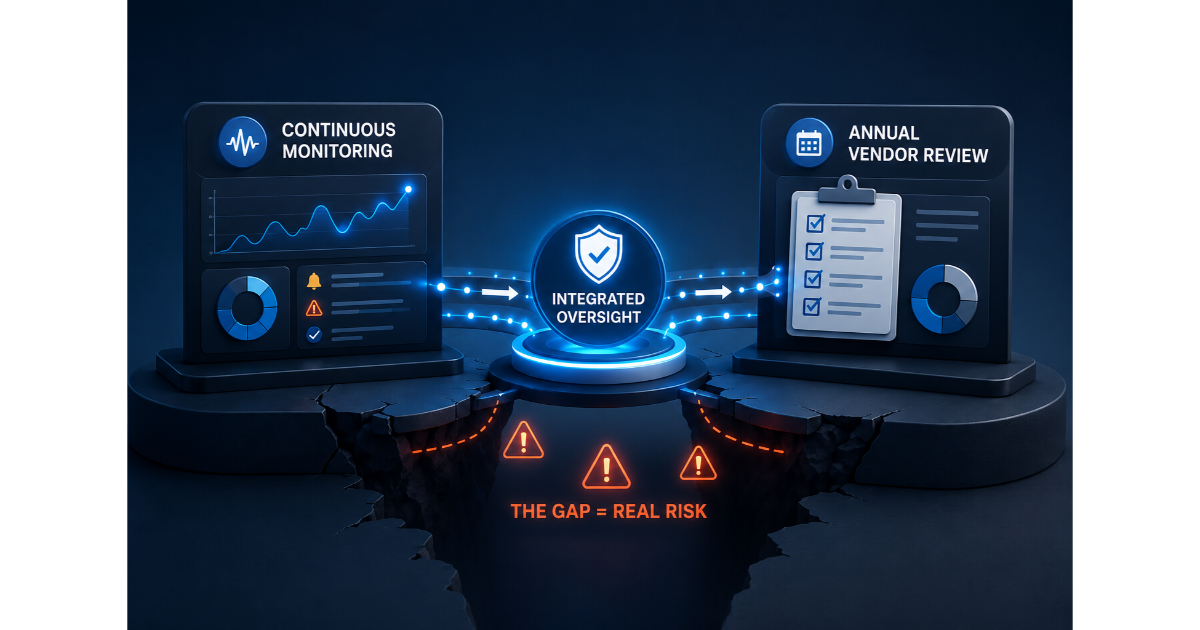
Different risk types call for different monitoring cadences, not one blanket review schedule. Financial and strategic risk tend to shift slowly and get checked periodically, often annually for most vendors. Cybersecurity and operational risk can change overnight and benefit from continuous monitoring rather than a quarterly check. Continuous vendor risk monitoring covers how that ongoing tracking actually works in practice.
Should every vendor be assessed against every risk type?
No, and trying to run every category against every vendor evenly tends to waste effort without improving coverage where it matters. A low-criticality vendor with no data access doesn't need the same cybersecurity scrutiny as one handling customer records. Matching the depth of assessment to what's actually relevant for each vendor, rather than defaulting to the same checklist for all of them, is what keeps a risk program sustainable as the vendor list grows.
How ComplyScore® Keeps Each Risk Type Visible
Most platforms solve this by giving every vendor one overall risk score, which is exactly the blending problem this piece opened with.
ComplyScore® tracks financial, operational, cybersecurity, compliance, and concentration risk as separate signals per vendor, not one blended score. A vendor's cybersecurity exposure stays visible even when their financial and operational standing are strong, so a real gap in one category doesn't get diluted into an acceptable-looking average.
That separation also drives the monitoring cadence automatically. A vendor tagged high-criticality with system access gets continuous cybersecurity tracking without someone manually deciding that vendor needs closer attention. A low-criticality vendor with no data access doesn't get the same overhead applied by default. The assessment depth follows what the vendor actually represents, without a person having to make that call for every vendor individually.
If your current risk scoring is collapsing distinct exposures into one number per vendor, book a demo to see how ComplyScore® keeps each risk category visible instead of averaging it away.



.png?width=200&height=45&name=ComplyScore%20Logo%20Transparent%20(1).png)


.webp?width=869&height=597&name=image%20(5).webp)


-1.png?width=486&height=315&name=IDC%20Banner%20(1)-1.png)



.png?width=300&height=175&name=Rectangle%2034624433%20(2).png)


.webp?width=1280&height=720&name=Medtech%20Breakthrough%20Award%20Winner%20(1).webp)













%20(1).jpg)