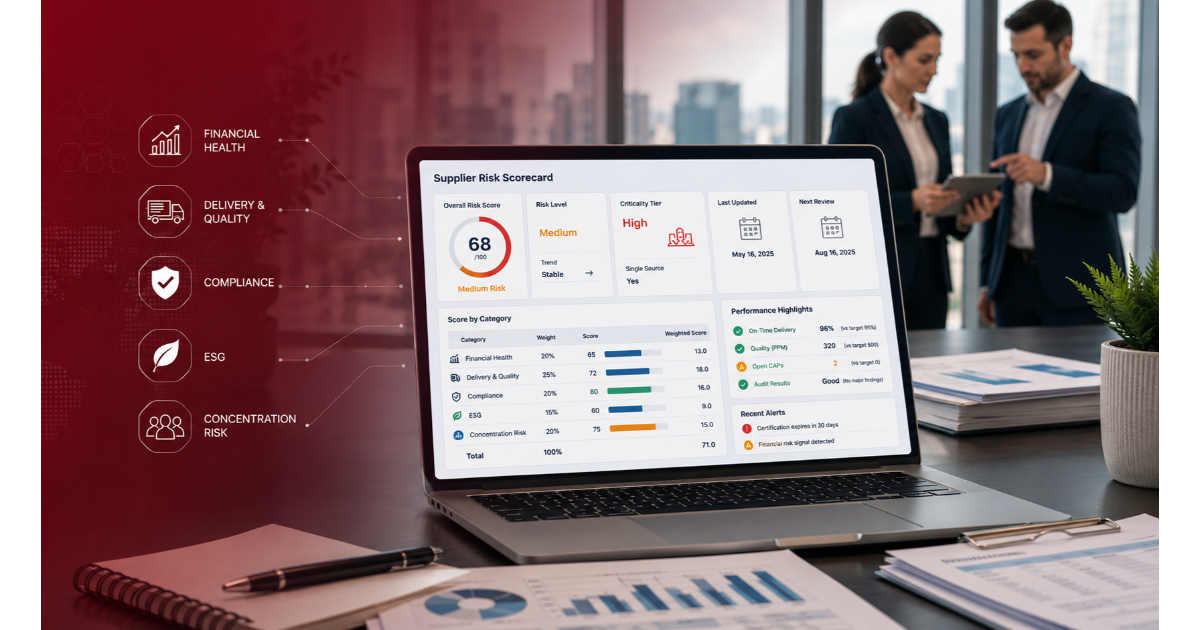
Most descriptions of the operational risk management process stop at assessment, as if identifying and scoring a risk were the finish line. It is closer to the starting line. The part that actually reduces exposure, remediation, ownership, and verifying the fix worked, is where most processes lose momentum and where most of the real risk reduction should be happening.
What Is the Operational Risk Management Process?
The operational risk management process is the sequence an organization follows to move from identifying a risk to confirming it has been reduced to an acceptable level, tracked and documented at every step.
It typically runs through inherent risk scoring, assessment, findings and remediation, and a final residual risk close-out, with each stage feeding data into the next.
Inherent Risk Scoring Before Assessment Begins
Before a full assessment starts, an inherent risk score establishes a baseline: how risky is this process, vendor, or system before any controls or remediation are applied. This score typically draws on a configurable set of weighted questions covering likelihood and impact, producing a heat map that shows which risk domains actually need deep review and which can move through a lighter-touch process.
Skipping this step is a common source of wasted effort and a direct hit to operational efficiency. Without an inherent risk baseline, organizations often apply the same depth of review to every risk regardless of actual exposure, burning analyst time on low-stakes items while high-stakes ones wait in the same queue.
Assessment, Findings, and Remediation Ownership
Assessment and scoring
The formal assessment tests the inherent risk against actual evidence, whether that is a control questionnaire, a document review, or direct system access. Automated evidence review, now built into most modern operational risk management tools, can handle a meaningful share of this work by mapping submitted documentation directly to specific control questions, though this still requires human review for anything flagged as a gap.
Findings and gaps
Assessment findings need to be specific enough to act on. A finding that says "insufficient documentation" gives an owner nothing to fix. A finding that names the exact control gap and the evidence that would close it moves the process forward instead of generating a follow-up conversation just to clarify what was actually found.
Remediation ownership
Every finding needs a named owner and a deadline the moment it is logged, not after a follow-up meeting determines who should have owned it. Findings that sit unassigned for even a short window are the ones most likely to still be open at the next audit cycle.
Residual Risk and Close-Out
Residual risk is what remains after remediation, and it is the number that should actually drive a go or no-go decision. A vendor with a high inherent risk score that completes strong remediation can end up with acceptable residual risk. A vendor with a moderate inherent score that skips remediation can end up worse off than the original assessment suggested.
Close-out should produce a clear, auditable record: what was found, what was fixed, what residual risk remains, and who approved moving forward despite it. That's exactly the record an operational audit risk assessment expects to find. Organizations that skip formal close-out tend to lose it entirely, leaving auditors to reconstruct decisions from email threads months later.
How ComplyScore® Runs This Process End to End
As part of its operational risk management platform, ComplyScore® generates an inherent risk score automatically before a full assessment begins, so review depth scales to actual exposure instead of applying uniform scrutiny across every vendor. Assessment findings convert directly into tracked remediation tasks with an assigned owner and due date, removing the gap between identifying an issue and someone being accountable for it.
Close-out reports compare inherent and residual risk scores side by side, generated automatically from the same workflow data used throughout the assessment, so the final record is always current rather than reconstructed manually at quarter-end.
See how ComplyScore® runs the full process from inherent risk to close-out. Book a demo







.webp?width=387&height=387&name=headless-tprm%20(1).webp)









































.webp)

%20(1).jpg)

.webp)
.webp)