Search for supplier risk assessment and most of what comes up is written for IT vendors: data access, breach history, security certifications. That's genuinely useful when the supplier in question is a software platform. It tells you far less when the supplier is a manufacturer whose parts your production line depends on, where the risk that matters most is whether they keep shipping on schedule, not whether their firewall is configured correctly.
This guide focuses on the version of supplier risk assessment built around that gap: production, financial, and concentration exposure, alongside the compliance factors most existing frameworks already cover well.
What Is a Supplier Risk Assessment?
A supplier risk assessment is a structured evaluation of the risk a supplier introduces to your business, scored across categories such as financial health, operational reliability, concentration exposure, and compliance. It turns a mix of documents, history, and judgment into a consistent score your team can act on.
The real value of an assessment lies less in the specific score and more in its consistency. Two analysts assessing the same supplier, or the same analyst assessing two different suppliers, should land on comparable results if they're using the same framework. Without that consistency, a risk score becomes a matter of who happened to review the file, rather than a reliable signal your organization can act on.
Start With Criticality, Not the Category Scores
A supplier you could replace within a week carries a different risk profile than one you can't substitute without months of requalification, even when both look similar on a standard risk questionnaire. Before scoring any individual risk category, tier suppliers by two questions: how hard would this supplier be to replace, and how much of your output depends on them.
Skipping this step is the most common reason assessment programs lose credibility internally. When a low-criticality office supplies vendor gets the same depth of review as the single-source component manufacturer keeping your production line running, analyst time gets spread evenly across risks that are anything but evenly distributed. The result is thorough documentation on suppliers that barely matter and thin coverage on the ones that do.
Core Risk Categories to Score
Financial health
Liquidity, debt load, payment history, and how concentrated a supplier's revenue is across their own customer base all belong here. A supplier carrying high debt relative to revenue, or one drawing most income from a single large client, is exposed to shocks that a more diversified supplier can absorb.
Financial distress tends to surface in the numbers before it surfaces in your deliveries. A widening gap between receivables and payables, or a slowing payment cycle to their own vendors, are signals worth tracking on an ongoing basis rather than checking once a year.
Production and operational reliability
Capacity utilization, the existence of backup facilities, and historical on-time performance tell you how much slack a supplier has when something goes wrong, whether that's a machine breakdown, a labor shortage, or a spike in your own order volume.
A supplier running near full capacity with no backup site carries more risk than their score alone might suggest, even if their historical delivery record looks strong. Past performance under normal conditions says little about what happens once conditions stop being normal.
Geographic and supplier concentration
Map how much of a given component, material, or service category runs through a single supplier or region. This kind of single-source supplier risk tends to build quietly, often as the by product of reasonable sourcing decisions made one at a time, until an external event, a factory fire, a port closure, a regional shortage, turns a theoretical risk into an active disruption.
ESG and regulatory exposure
Labor practices, environmental compliance, and general regulatory standing affect both your direct risk exposure and, increasingly, your own reporting obligations under supply chain disclosure rules. This category has grown in weight as more jurisdictions require visibility into supplier practices, beyond your own operations alone.
Where Inherent and Residual Risk Still Fit
If your organization already runs a broader vendor risk program, you're likely familiar with inherent and residual risk. Inherent risk is the raw exposure before any controls are applied, and residual risk is what remains once those controls, insurance, contract terms, dual sourcing, are factored in. The same framework applies to suppliers, and it's worth applying rather than reinventing a separate model.
A supplier with high inherent risk but strong controls, dual-sourced inputs and comprehensive insurance, for example, may carry meaningfully lower residual risk than the raw score suggests. For the full breakdown of how to calculate and apply this framework, our guide to inherent risk versus residual risk covers it in more depth than we will here.
Building a Scoring Model That Reflects Supplier Criticality
A single scoring model applied uniformly across every supplier tends to produce results that are internally consistent but not especially useful. Weighting should shift with criticality. For a single-source, business-critical supplier, concentration and production reliability should carry more weight than for a supplier you could swap out in a week.
This means the same raw facts can produce different scores depending on context, and that's intentional. A supplier operating from a single facility is a minor note for a low-criticality relationship and a major flag for one you can't easily replace. If you're evaluating platforms to run this scoring at scale, our breakdown of what to look for in a supplier risk assessment tool covers the selection criteria in detail.
Common Mistakes in Supplier Risk Assessment
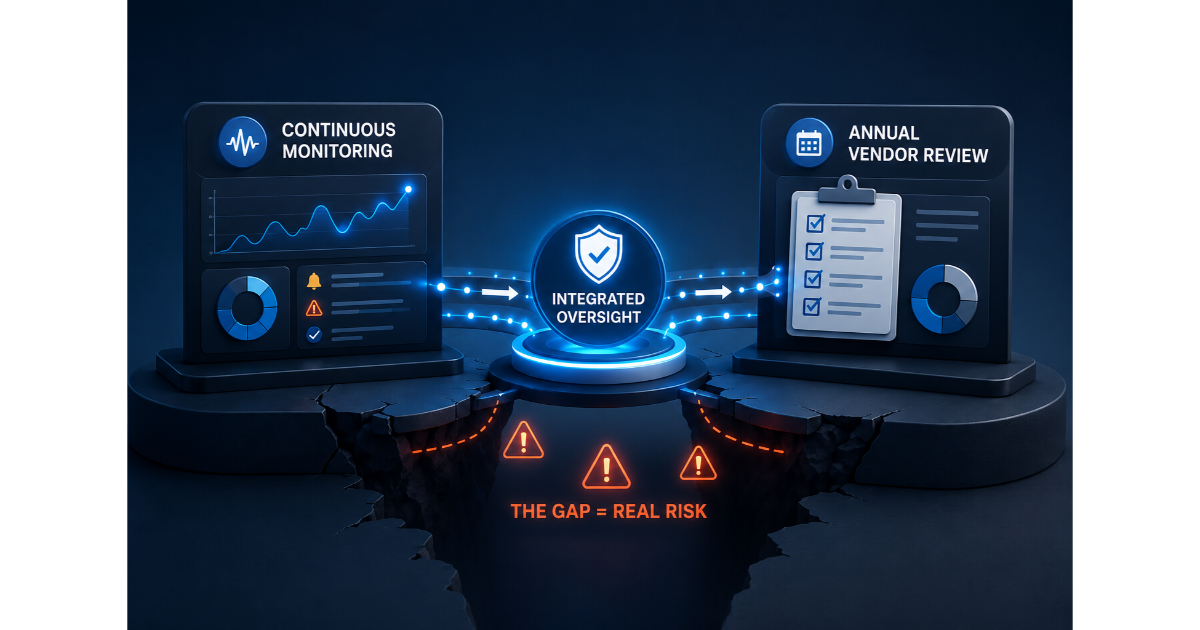
The most frequent mistake is treating assessment as a one-time event rather than an ongoing process. A score from eighteen months ago reflects conditions that may no longer exist, particularly for suppliers in volatile markets or going through their own growth.
The second is scoring risk categories in isolation rather than looking at how they interact. A supplier with moderate financial risk and moderate concentration risk, viewed separately, might each look manageable. Combined, they describe a supplier who can't easily absorb a shock and who you can't easily replace if they don't, which is a meaningfully different exposure than either factor suggests alone.
How ComplyScore® Automates Supplier Risk Assessment
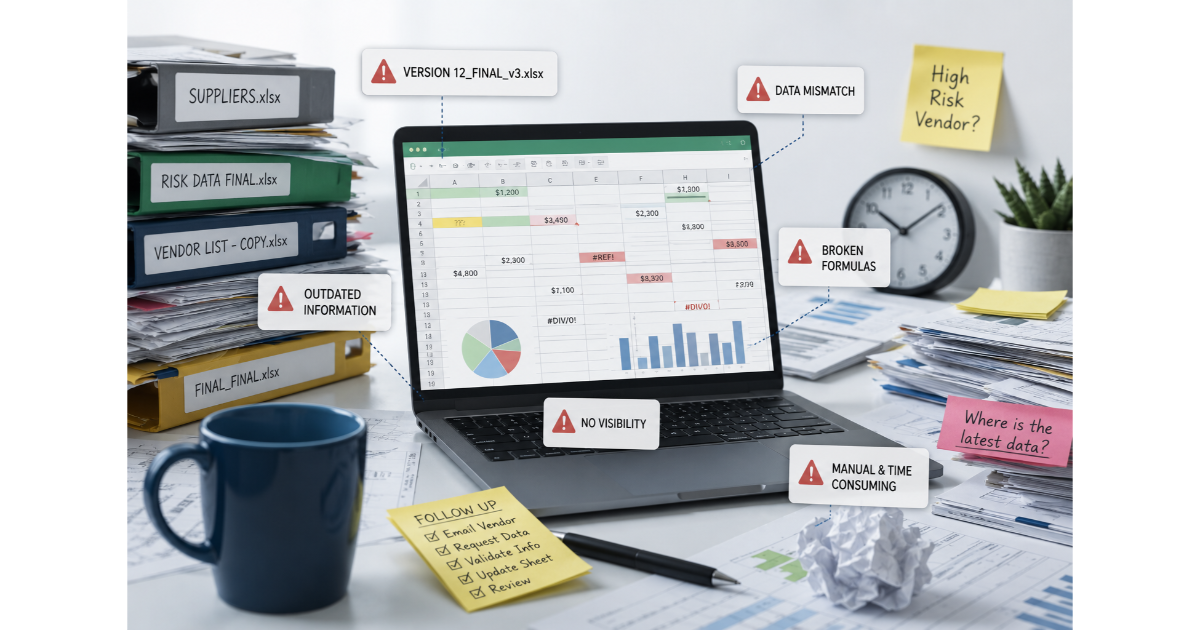
ComplyScore®'s supplier risk management platform applies criticality-based tiering automatically, directing deeper scrutiny toward the suppliers where it matters most and moving lower-risk suppliers through a lighter, faster path. Assessment cycles that typically take thirty to forty-five days when run manually complete in under ten days on the platform, without cutting the depth of review for the suppliers carrying the most exposure.
Coverage improves for the same reason. Programs that manually monitor a quarter to a third of their supplier base commonly reach ninety to ninety-five percent coverage once assessment and monitoring stop depending entirely on analyst bandwidth.
Book a demo to see how ComplyScore® tiers suppliers by criticality on your own portfolio.







.webp?width=387&height=387&name=headless-tprm%20(1).webp)










































%20(1).jpg)