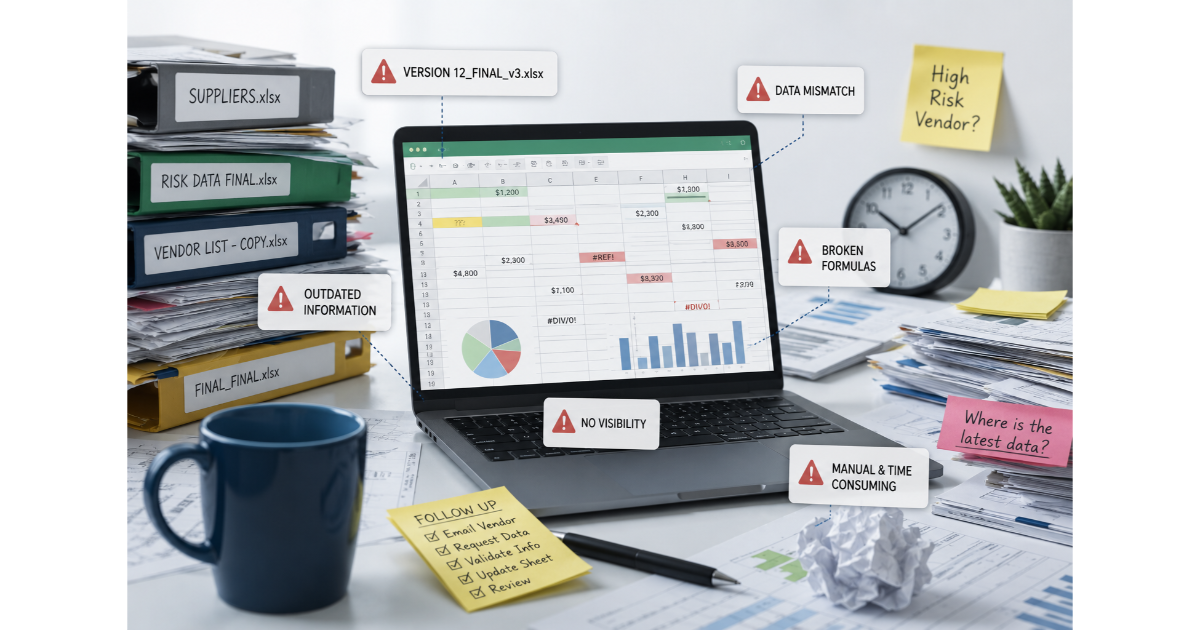
The point where a spreadsheet stops working for supplier risk tends to be a complexity threshold rather than a simple headcount number, driven by multiple business units, multiple systems, and suppliers spread across regions that don't share the same rules.
Enterprise supplier risk management is less about the volume of suppliers and more about governing consistency across an organization that no longer fits inside one team's view.
What Makes Supplier Risk Enterprise-Scale?
Enterprise supplier risk management refers to overseeing supplier risk across a large, complex organization, typically spanning multiple business units, regions, and systems, where consistency and governance matter as much as the underlying risk data itself.
Structural Challenges at Scale
Fragmented ownership across business units
Different divisions often manage supplier relationships independently, each with its own criteria, its own tools, and no shared view of a supplier that spans the whole organization. This usually reflects how divisions grow and build their own processes to solve their own immediate needs, rather than any failure on one team's part.
The consequence shows up later, often during a merger, an audit, or a major supplier failure, when leadership asks a simple question, how exposed are we to this supplier across the whole company, and no single team can answer it without weeks of manual reconciliation.
Inconsistent tiering
Without a shared methodology, the same supplier can be classified as high-risk in one business unit and low-risk in another, purely because each unit built its own criteria in isolation. Neither classification is necessarily wrong on its own terms. Together, they make it hard to get an accurate enterprise-wide picture.
Multi-system vendor masters
Vendor and supplier data living across separate ERPs, procurement platforms, and spreadsheets makes it difficult to get an accurate count of who your suppliers even are, let alone a consistent risk profile for each one. Duplicate records across systems are common and rarely get reconciled until someone needs an answer urgently.
Cross-region regulatory variance
A supplier program that satisfies requirements in one country may fall short in another, and enterprise programs need to account for that variance without building an entirely separate process for every region. The goal is a shared core with regional layers added on top, not a patchwork of unrelated programs.
Governance Model: Centralized, Federated, or Hybrid
A centralized model puts one team in charge of policy and tiering across the organization, which improves consistency but can slow decisions for business units with genuinely unique needs. A federated model gives each unit control over its own process, which moves faster locally but reintroduces the inconsistency described above.
Most enterprise programs eventually land on a hybrid: centralized policy and risk criteria, with federated execution. Business units run their own day-to-day assessments, but against a shared methodology, scoring model, and system of record, so results can be compared and aggregated across the organization.
Standardizing Risk Criteria Across Business Units
The fastest route to fixing fragmented tiering is a shared supplier risk assessment tool with consistent risk categories and weighting logic that every business unit applies, even if the specific suppliers, thresholds, and priorities differ by unit. This doesn't require every division to manage identical suppliers. It requires identical criteria for evaluating whichever suppliers each division works with.
Rolling this out usually works better in stages than all at once. Standardizing the highest-criticality suppliers first, then expanding coverage, tends to produce faster wins and less internal resistance than converting every business unit's entire supplier base in a single push.
Technology Requirements at Enterprise Scale
Enterprise supplier risk management depends on a platform that can integrate with multiple ERPs at once, support role-based access across business units, and maintain a single audit trail regardless of where an assessment originated. Without this foundation, even a well-designed governance model breaks down at the point of actual execution.
This is where many enterprise programs stall, not from a lack of policy, but from a lack of technical infrastructure to support it. A well-written governance policy that still requires manual data reconciliation across five systems isn't operational, however sound the policy itself is.
How ComplyScore® Supports Enterprise-Scale Programs
ComplyScore®'s supplier risk management platform connects to multiple ERPs in parallel, including SAP, Oracle, JD Edwards, and Infor LN, so vendor and supplier data stays synchronized across divisions without requiring a single, disruptive migration event.
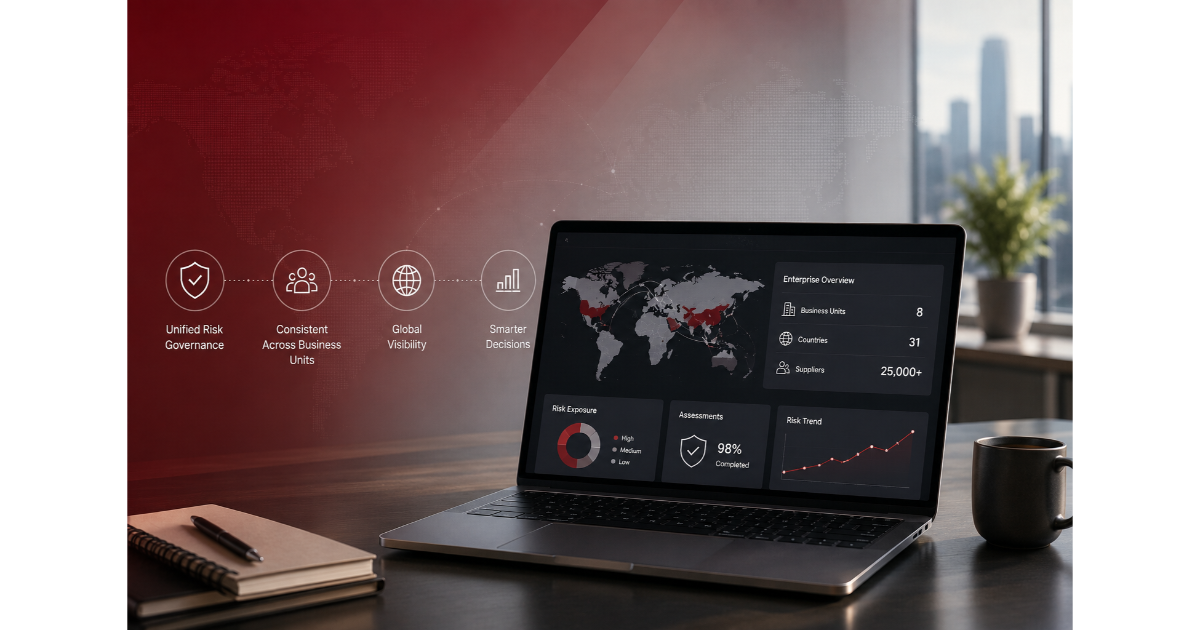
One global manufacturer went live across twenty-five thousand vendors, three ERP systems, and thirty-one countries by rolling out division by division rather than all at once, with the first division live within weeks. That staged approach, tackling standardization one part of the organization at a time rather than all at once, is often what makes enterprise-scale programs achievable in the first place.
Book a demo to see how ComplyScore® handles multi-ERP, multi-region rollouts.





.webp?width=387&height=387&name=headless-tprm%20(1).webp)



































%20(1).jpg)