








.webp?width=387&height=387&name=Medtech%20Breakthrough%20Award%20Winner%20(1).webp)



























Provider Lifecycle Management
Summarize This Article With
Most health plans do not have a provider data problem. They have a provider data architecture problem. The information exists in credentialing tools, the directory, the claims engine, the CRM, and a dozen delegated feeds. Each system holds a slightly different version of the truth, and no one system has authority over the others.
A provider data hub solves the architecture problem before it becomes an operations problem. It establishes one authoritative record that every downstream system reads from, and one place where every upstream change is reconciled.
What Is a Provider Data Hub and Why Is It the Backbone of Modern Healthcare Data Management?
A provider data hub is a centralized platform that consolidates provider information from every source a health plan uses, applies validation and reconciliation rules, and serves a single trusted record to every system that needs it. The hub sits between upstream sources like delegated rosters and CAQH and downstream systems like the directory, claims engine, and credentialing platform.
Without a hub, every system maintains its own copy of provider data and synchronization happens through batch files, manual reconciliation, or hope. With a hub, synchronization is built into the architecture. Changes propagate from one validated record rather than fighting their way through five disconnected copies.
Why Is Fragmented Provider Data Silently Draining Health Plan Revenue and Patient Trust?
Fragmentation costs health plans in three places at once:
- Revenue leaks through denied claims, out-of-network leakage, and clean-claim failures.
- Operations spend hours every week scrubbing, reformatting, and rekeying data that should have been correct on arrival.
- Member experience suffers when directory errors send patients to providers who closed, retired, or stopped accepting their plan.
How Does a Provider Data Hub Establish a Single Source of Truth Across All Provider Systems?
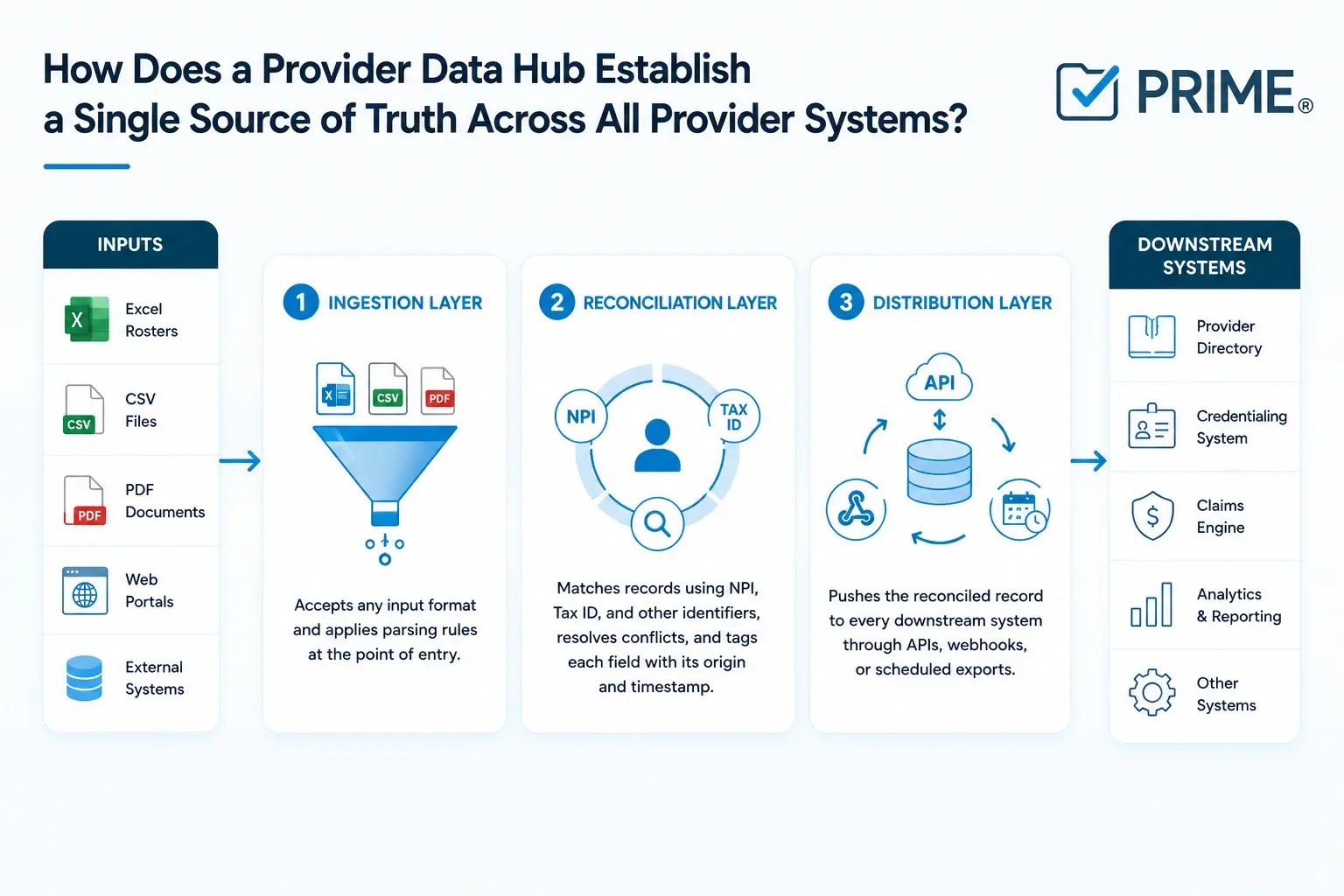
A hub establishes a single source of truth through three architectural layers that work together.
The ingestion layer accepts any input format and applies parsing rules at the point of entry.
The reconciliation layer matches records using NPI, Tax ID, and other identifiers, resolves conflicts based on source authority, and tags each field with its origin and timestamp.
The distribution layer pushes the reconciled record to every downstream system through APIs, webhooks, or scheduled exports.
Get a PRIME® demo to see how it works. Book now!
As a result, when a delegated group sends an Excel roster with three new providers and two terminations, those changes appear in the directory, credentialing system, and claims engine within hours, not weeks. Every record carries its source attribution, so when an error is flagged, it traces back to the exact upstream feed.
How Can a Provider Data Hub Improve Provider Directory Accuracy and CMS Compliance?
Directory accuracy improves with a provider data hub because every directory entry is fed from a record that has already passed validation. The hub validates each field against authoritative sources, including NPPES, state medical license boards, OIG LEIE, and SAM.gov, before any downstream system sees the data. Compliance improves because every change is logged with a timestamp and source, producing the audit trail that CMS and HHS now require.
The REAL Health Providers Act, signed in February 2026, requires Medicare Advantage organizations to verify provider directory data every 90 days, remove departed providers within five business days, and submit annual accuracy analyses to HHS. From plan year 2029, CMS will publish those accuracy scores publicly. Plans relying on quarterly batch processes cannot meet those requirements. But pans operating from a hub can.
How Does a Centralized Provider Data Hub Reduce Claim Denials and Drive Operational Efficiency?
Claim denials drop with a centralized provider data hub because the provider record on the claim matches the record in the adjudication system. Premier Inc.'s national survey found that 15% of Medicare Advantage claims are initially denied, and provider data mismatches are a documented contributor. When a hub maintains identifier consistency across credentialing, directory, and claims, the upstream causes of mismatch denials largely disappear.
Operational efficiency follows the same logic. The 2025 CAQH Index estimates a remaining $21 billion annual savings opportunity from automating manual administrative transactions.
A hub captures a meaningful portion of that opportunity because it eliminates the rekeying, reformatting, and reconciliation work that consumes provider operations teams.
What Should Health Plans Prioritize When Evaluating a Provider Data Hub Solution?
The market includes platforms that call themselves hubs but operate as data warehouses, which is a different category. A real hub does five things that a warehouse does not.
- Ingests any input format from any upstream source without manual pre-cleaning
- Reconciles records based on identifier matching and configurable source authority rules
- Tags every field with source attribution, timestamp, and confidence score
- Distributes validated records to downstream systems through APIs, webhooks, or scheduled feeds
- Produces a complete audit trail that satisfies CMS, HHS, and state regulatory requirements
PRIME® by Atlas Systems was built around these requirements. The Provider Data Management Engine at the core of PRIME® serves as the single source of truth for health plan provider data, and the platform supports FHIR-based exchange, ISO and SOC 2 security certifications, and continuous validation against authoritative sources.
Get a demo to see how PRIME® can centralize provider data in your organization.

%20(1).jpg)

Related Reading


Provider Lifecycle Management
Best Provider Network Management Platforms for Payers and Providers in 2026
Read the blog →
Provider Lifecycle Management
Best Provider Directory Validation Companies for Health Plans in 2026
Read the blog →

Provider Lifecycle Management
CMS Regulations for Behavioral Health Providers: A Compliance Breakdown
Read the blog →
Provider Lifecycle Management