A supplier can hold every certification you require, pass every audit, and still miss deliveries or ship inconsistent quality. Compliance and performance measure different things, and a risk program that tracks only one is working from an incomplete picture.
What Is Supplier Performance Risk?
Supplier performance risk is the risk that a supplier fails to deliver goods or services at the quality, volume, or timeline your business needs, regardless of their compliance or financial standing. It's measured through operational outcomes rather than documentation.
Performance Risk vs Compliance Risk vs Financial Risk
These three risk types often get grouped together, but each answers a different question. Compliance risk asks whether a supplier meets regulatory and contractual requirements. Financial risk asks whether a supplier is stable enough to keep operating. Performance risk asks something more immediate: do they actually deliver, on time and to spec, day after day.
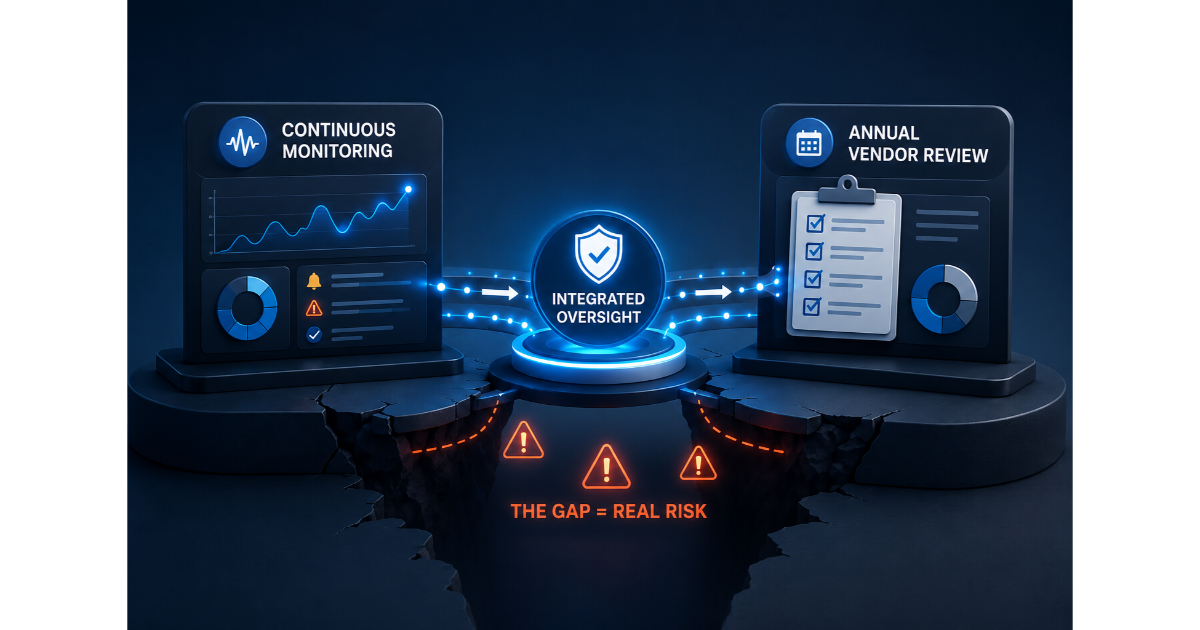
A supplier can score well on two of these and still fall short on the third, which is exactly why folding performance into a single supplier risk assessment tends to hide the signal that matters most for day-to-day operations. Tracking the three separately is what lets a team catch a performance decline before it shows up anywhere else.
Common Drivers of Performance Risk
Quality drift
Small, gradual declines in quality that stay just under a rejection threshold for months can go unnoticed until a batch fails outright. The drift itself is often the more useful signal than any single failed shipment, because it shows a direction rather than a one-off.
Delivery delays
Late shipments frequently start as isolated, explainable incidents before settling into a pattern. That pattern is often tied to capacity strain the supplier hasn't disclosed, either because they don't see it as material yet or because they're hoping to work through it quietly.
Capacity constraints
A supplier who has taken on more customers than their production capacity can reliably serve tends to show it first as inconsistent lead times, rather than an outright refusal to commit to a delivery date.
Communication breakdowns
Delayed or vague updates when something goes wrong are often the earliest warning sign of all, and the easiest one to miss, because it doesn't show up in a spreadsheet the way a missed delivery date does.
How to Measure Performance Risk
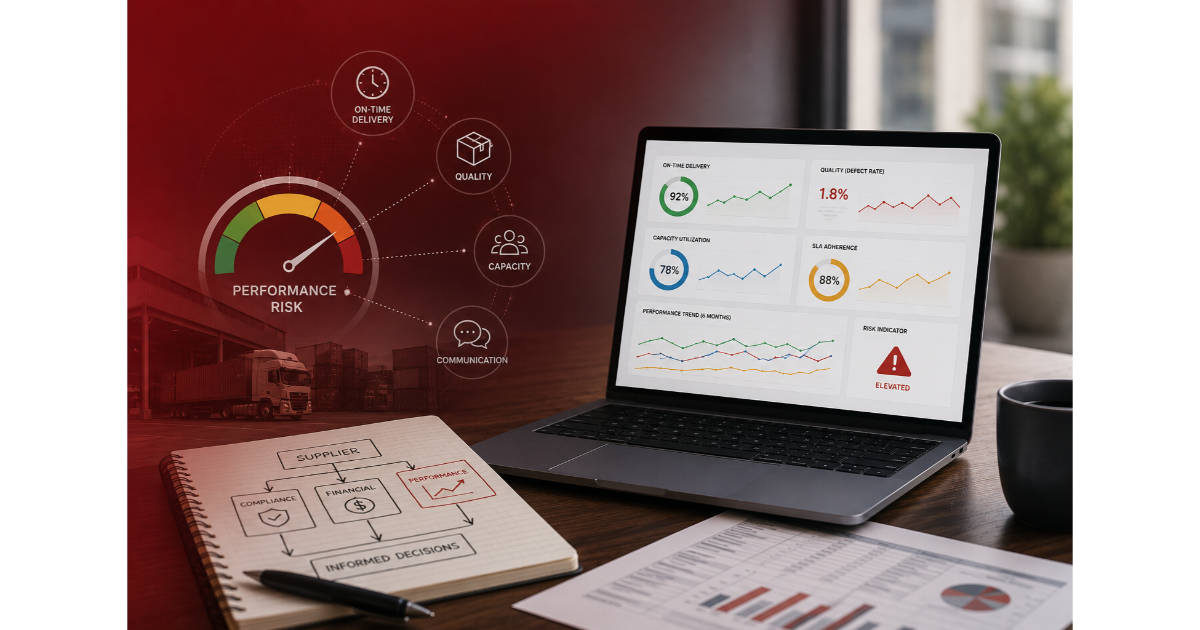
On-time delivery rate, defect or rejection rate, and SLA adherence form the core of most performance tracking. None of these need to be complicated to be useful.
What matters more than any single number is the trend. A supplier holding steady at ninety-five percent on-time delivery is telling a different story than one that dropped from ninety-eight to ninety percent over two quarters, even though both currently sit above a typical threshold. The trend line is where the early warning lives.
When Performance Risk Compounds Into Something Bigger
Performance issues rarely stay contained to performance alone. A supplier struggling with capacity often cuts corners on quality to protect delivery commitments, or misses deliveries outright to protect quality, and either choice has knock-on effects for you.
Left untracked, performance risk tends to compound into financial risk as a supplier absorbs hidden costs to mask a shortfall, and eventually into a continuity risk once they can no longer manage either. Catching it at the performance stage, while it's still an isolated trend, is considerably cheaper than catching it later.
How ComplyScore® Tracks Performance Alongside Compliance
ComplyScore®'s supplier risk management software tracks performance KPIs on the same platform as compliance and financial data, so a quality trend and a lapsed certification appear in the same view rather than two disconnected systems that different teams check on different schedules.
That combined view is what allows a team to connect a declining delivery trend with, say, a recent ownership change or a drop in a supplier's credit signal, rather than treating each data point as an isolated event with no relationship to the others.
Book a demo to see performance, compliance, and financial signals tracked in one view.



.png?width=200&height=45&name=ComplyScore%20Logo%20Transparent%20(1).png)


.webp?width=869&height=597&name=image%20(5).webp)


-1.png?width=486&height=315&name=IDC%20Banner%20(1)-1.png)



.png?width=300&height=175&name=Rectangle%2034624433%20(2).png)


.webp?width=1280&height=720&name=Medtech%20Breakthrough%20Award%20Winner%20(1).webp)












%20(1).png)