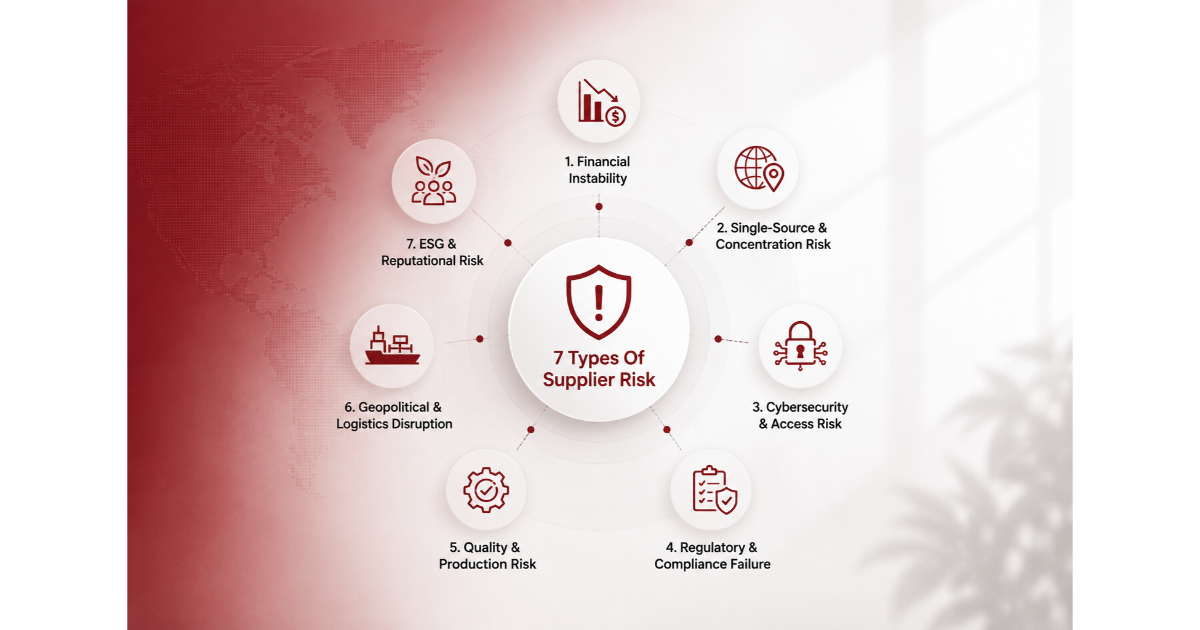
Supplier risk spans several distinct categories, financial, operational, compliance, and external, and each one can disrupt a business in a different way. Below are seven, with a practical example for each, to make the difference between them concrete rather than abstract.
What Counts as Supplier Risk?
Supplier risk is any risk that arises from a business's dependence on an external supplier for goods or services, spanning financial stability, operational reliability, compliance, cybersecurity, and external factors like geopolitics and natural disasters.
1. Financial Instability
A supplier facing cash flow strain, mounting debt, or heavy reliance on one large customer may struggle to fulfill orders, even with every intention of doing so.
Suppose a mid-sized components supplier loses its largest customer, who represented forty percent of its revenue. Even if the supplier's remaining relationships are healthy, that sudden gap can force cuts to raw material purchases or staffing, which shows up on your end as slower response times or reduced order flexibility, months before any formal notice of trouble.
2. Single-Source and Concentration Risk
Relying on one supplier, or one region, for a critical input means any disruption there becomes your disruption too. This kind of single-source and concentration risk tends to build quietly, often as a side effect of cost optimization, rather than arriving all at once.
For instance, a company might consolidate a component from three regional suppliers down to one overseas supplier for better pricing. The decision looks sound on a cost sheet. It only becomes visible as a risk when that single facility faces a regional power outage or shipping delay, and there's no alternative source to fall back on.
3. Cybersecurity and Access Risk
Suppliers with access to your systems or data introduce a security exposure that has nothing to do with what they physically deliver. A supplier's weak security posture can become your incident.
Suppose a logistics partner with access to your shipment scheduling system suffers a credential breach. Even though the breach originated entirely outside your organization, the exposure runs directly into your own data and operations through that connection.
4. Regulatory and Compliance Failure
A supplier operating outside required certifications, safety standards, or trade regulations can expose you to fines, shipment holds, or reputational damage, even when you weren't the one who broke a rule.
For example, a supplier shipping a product without a required safety certification for a specific market can trigger a customs hold on your shipment, delaying delivery to your own customers over an issue that originated entirely on the supplier's side.
5. Quality and Production Risk
Inconsistent quality, capacity constraints, or production line issues at a supplier translate directly into defects, delays, or recalls downstream. This risk to OEM production lines tends to build gradually rather than arrive suddenly, which makes it easy to underestimate until it's already affecting your own product.
Suppose a supplier switches a raw material source to cut costs without notifying you. The change might pass initial inspection, then show up weeks later as a higher failure rate in your finished product, well after the switch itself is easy to trace back.
6. Geopolitical and Logistics Disruption
Trade restrictions, port closures, regional conflict, or extreme weather can halt a supplier's ability to ship, regardless of how well-run they are otherwise. This category has grown more relevant as supply chains have become more globally interconnected.
For instance, a new tariff or export restriction introduced with little warning can strand inventory at a border or make a previously competitive supplier's pricing untenable overnight, independent of anything the supplier did or didn't do well.
7. ESG and Reputational Risk
Labor practices, environmental compliance, and sourcing transparency at a supplier increasingly reflect on your own brand, especially as customers and regulators expect visibility deeper into the supply chain than your direct suppliers alone.
Suppose an investigative report surfaces labor practice violations at a second-tier supplier three steps removed from your direct relationship. The reputational exposure rarely stays contained to that distant link. It tends to travel back up the chain to every brand whose product touched that supply chain, regardless of how far removed the direct relationship was.
How to Build a Program That Covers All Seven
Most supplier risk programs start by covering whichever category caused a past incident, then expand reactively from there. A stronger starting point is scoring every supplier across all seven categories from the outset using a supplier risk assessment tool, weighted by how material each one is to that specific relationship, rather than waiting for a gap to become obvious the expensive way.
Not every category deserves equal weight for every supplier. A software vendor and a raw materials supplier will reasonably score differently across these seven, and building that differentiation in is what keeps an assessment useful rather than a uniform checklist applied everywhere. ComplyScore®'s supplier risk management software scores suppliers across all seven categories in one place, weighted by criticality, so none of them end up as a blind spot by default.
Book a demo to see all seven risk categories scored on one supplier record.



.png?width=200&height=45&name=ComplyScore%20Logo%20Transparent%20(1).png)


.webp?width=869&height=597&name=image%20(5).webp)


-1.png?width=486&height=315&name=IDC%20Banner%20(1)-1.png)



.png?width=300&height=175&name=Rectangle%2034624433%20(2).png)


.webp?width=1280&height=720&name=Medtech%20Breakthrough%20Award%20Winner%20(1).webp)













%20(1).jpg)