







.webp?width=387&height=387&name=Medtech%20Breakthrough%20Award%20Winner%20(1).webp)



























Provider Lifecycle Management
Summarize This Article With
Almost half of your members are now using AI to find a doctor. The answer they receive depends on what your hosted provider directory actually contains.
For health plans, that is a data infrastructure question that has been building for years, now visible in a channel you do not control and cannot correct in real time.
When Members Search for a Provider, AI Answers First
A June 2026 survey by rater8, covering more than 900 U.S. adult patients, found that 47% have used an AI tool to research or find a healthcare provider, up from 31% just nine months earlier. Among patients who ultimately switched providers, AI was the single most influential source in their decision, outranking Google search results as a driver of provider selection for the first time.
Your members are no longer starting their provider search on your member portal or calling your member services line. They are opening ChatGPT, querying Google's AI Overview, or using Perplexity. They type something like "cardiologist near me who takes Blue Cross," and within seconds they have a name, a phone number, an address, and a note on whether that provider is accepting new patients.
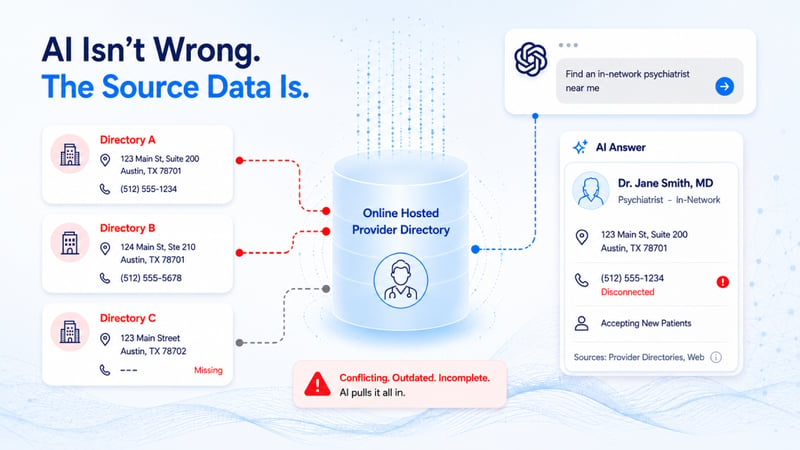
The accuracy of that answer depends on the sources AI pulls from, and your hosted provider directory is one of them.
Why Inaccurate Source Data Produces Inaccurate AI Answers
The rater8 survey found that 66% of patients who used AI to research providers encountered incorrect information, including wrong office addresses, phone numbers, insurance details, and office hours. Despite that, 60% of those same patients trusted the AI summary they received without verifying it elsewhere.
AI tools synthesize answers from publicly available sources, including health plan directories, third-party provider databases, and the web pages that health plans and provider groups publish. When those underlying sources contain errors, AI reproduces those errors with the same confidence it reproduces accurate data.
A 2024 study published in BMC Health Services Research examined physician records across five major U.S. health insurer directories and found that address information was consistent across sources only 17% to 28% of the time, and phone numbers only 16% to 27% of the time. At best, one in four records contained consistent contact data across payer-owned directories. AI pulls from those same directories, and what it finds there is what your members will hear.
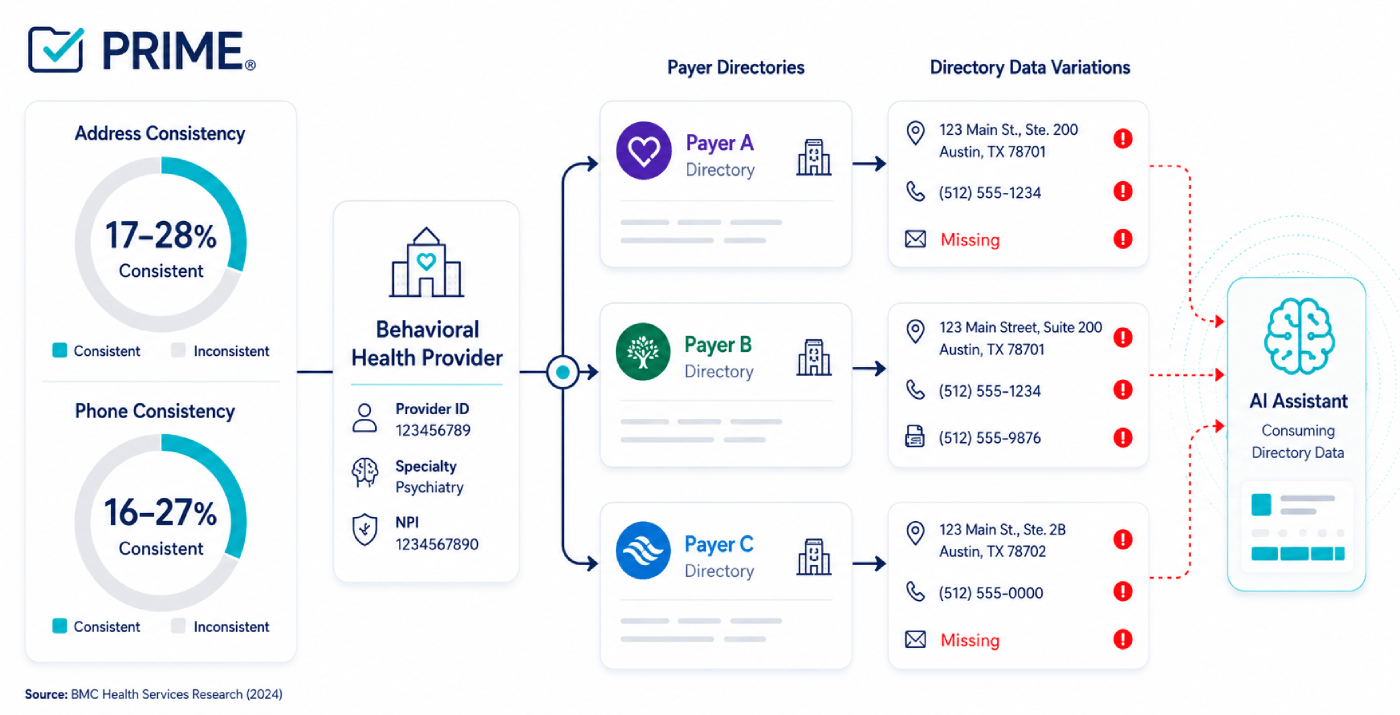
The inaccuracy in provider directories has existed for years. AI has become the channel that surfaces it directly to your members.
What Accurate Online Provider Directories Actually Require
Most health plan directory teams understand the compliance mandate well. CMS requires that provider directory updates be made within two business days of a confirmed change and that Medicare Advantage directories meet an 85% accuracy threshold. Beginning in 2027, directory data will appear publicly on Medicare Plan Finder, making online provider directory accuracy a visible factor for beneficiaries comparing plans during open enrollment.
What the compliance framework does not resolve is the underlying operational reality: provider data changes continuously, and most validation models are not built to match that pace.
For example, practices relocate without notifying payers, providers change their acceptance status between credentialing cycle, and group affiliations shift. A directory refreshed on a 90-day cycle accumulates months of stale records before the next validation run catches them, and by the time a quarterly update publishes, some of those corrections may already be outdated.
Single-source verification compounds the issue. Checking one database confirms one data point against one reference. It will not catch a revoked license that only appears on a state board's disciplinary records, or a federal exclusion that only appears on OIG's List of Excluded Individuals and Entities. Sustaining hosted provider directory accuracy requires multiple verification layers running continuously, not a quarterly pass through a single source.
CMS's national review found that 48.74% of provider locations in Medicare Advantage online directories contained at least one inaccuracy. That figure reflects the predictable outcome of a validation architecture built around compliance cycles rather than the actual rate at which provider data moves.
The Directories You Host Determine the Answers AI Gives
When a member asks an AI tool for a provider recommendation, the tool assembles its answer from whatever sources it can reach. For health plan members, that includes your member-facing online directory. The addresses, phone numbers, specialty codes, network status, and patient acceptance flags your hosted directory publishes become part of the source pool AI draws from.
Health plans that host frequently updated, validated online directories give AI accurate source material to work from. Health plans whose directories contain stale records, inconsistent addresses, or outdated acceptance status give AI inaccurate source material, and AI distributes that to every member who searches.
The member experience consequence is direct. A member searches for an in-network psychiatrist, receives a name and address from an AI tool drawing on your directory, drives to the location, and finds a practice that relocated eight months ago. That generates a member complaint, a potential grievance, and a data point in your CAHPS results.
How PRIME® Delivers Hosted Directories Built on Verified Data
PRIME® connects provider directory hosting directly to validated, continuously updated provider data, removing the separate data layer that requires manual maintenance.
The PRIME® Provider Directory Data Validation module runs verification through six layers:
- The provider's own website
- Public and government sources including NPPES and state license boards
- Federal and state exclusion screening across OIG LEIE and SAM.gov
- Cross-directory consistency analysis to surface conflicting records across payer systems
- Agentic AI outreach that places automated calls to provider offices to confirm availability and hours
- Human escalation for cases automated layers cannot resolve
That process sustains 95%+ accuracy across validated networks, with full audit trail documentation at every step.
PRIME®'s hosted online provider directory draws directly from those validated records. There is no separate file export, no manual hand-off to a vendor, and no lag between the credentialing system and what members see when they search.
Update cycles run on defined schedules, weekly, bi-weekly, or monthly, and high-priority changes such as practice closures push immediately.
Members searching through the hosted directory can filter by specialty, radius, gender, language, insurance acceptance, telehealth availability, and accessibility features. The directory is mobile-responsive, ADA-compliant, and embeddable within existing member portal environments, with your plan's branding applied throughout.
AI tools pull from sources they can access. A hosted provider directory powered by validated, continuously updated data gives those tools accurate records to work from. Your members are already asking AI about your network. What they find starts with what your directory holds.
See how PRIME® validates and hosts provider directories that reflect your network accurately. Schedule a demo with our team.

%20(1).jpg)

Related Reading

Provider Lifecycle Management
Automated Provider Data Management: A Practical Playbook
Read the blog →
Provider Lifecycle Management
The Complete Guide to Provider Data Management Automation
Read the blog →
Provider Lifecycle Management
Why Behavioral Health Providers Are the Hardest AWT Surveys to Close
Read the blog →
Provider Lifecycle Management
Best Provider Network Management Platforms for Payers and Providers in 2026
Read the blog →
Provider Lifecycle Management